
  • LAT
  • LIT
  • ENG
udbu
  • Home
  • About us
  • Product
    • Metalworking Machines
      • Laser Cutting Machines
      • CNC Metalworking Turning Centers
      • CNC Milling Machines
      • Swiss Type CNC Turning and Milling Machines
      • CNC Metalworking Press Brakes
      • Conventional Lathes
      • Conventional Milling Machines
      • Ultrasonic & Precision CNC Machines
    • Woodworking Machines
      • CNC CO2 Laser Cutting Machines
    • Equipment and tools
    • Ventilation equipment
      • Rekuperator
      • Flexible air ducts
      • Air distribution collectors
      • Difuzors
      • Other materials
    • AEON
    • Bellini
    • Conprofe
    • Flott
    • Gdw
    • Golden Laser
      • Sheet laser cutting machine
      • Tube laser cutting machines
    • Hanwha
    • Holzmann
    • Kafo
    • Oxygen
    • Pinacho
    • Putsch
    • Roeders
    • Ronix
    • Samchully
    • Seoam
    • SMEC
    • Warcom
    • Xtool
    • Yg-1
    • Bernardo
  • Blog
  • Contact
  • +371 68688313
  • +370 66106190
  • +372 6346313

Methods for Surface Roughness Control After Rough Machining
January 22, 2026 at 4:55 pm

Methods for Surface Roughness Control After Rough Machining

Introduction

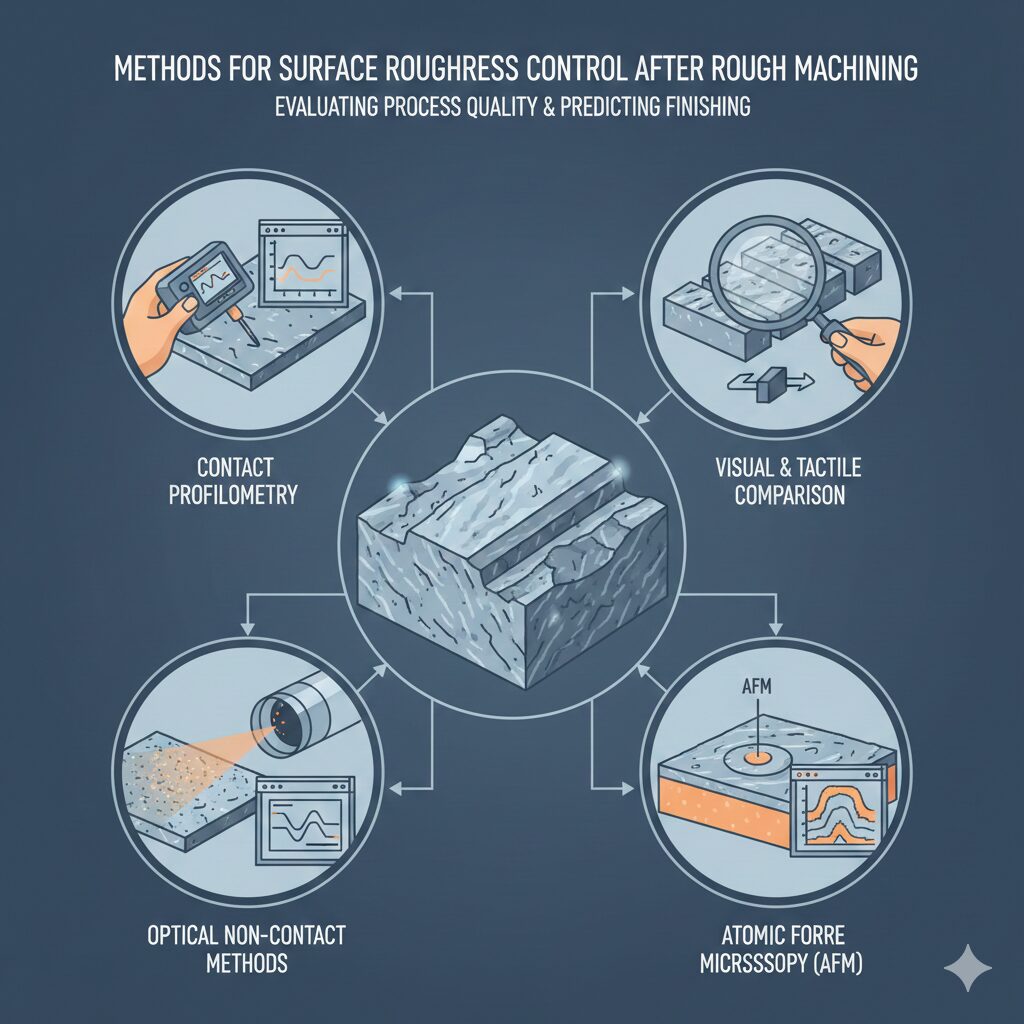
Rough machining is one of the first and most important stages in metal part manufacturing. At this stage, the basic geometry of the workpiece is formed, but the surface usually has increased roughness. Surface roughness control after rough machining helps evaluate process quality, predict finishing results, and identify issues related to tooling, cutting parameters, or machine condition at an early stage.

What Is Surface Roughness

Surface roughness is a set of micro-irregularities formed during the cutting process. It directly affects:

  • wear resistance of parts,

  • fit and mating quality,

  • coating adhesion,

  • accuracy of subsequent operations.

Key roughness parameters:

  • Ra – arithmetic mean deviation of the profile

  • Rz – average roughness height

  • Rt – total height of the profile

After rough machining, Ra values typically range from 2.5 to 12.5 µm.

Main Control Methods

Contact Methods

  • Contact profilometers – high accuracy, widely used in industry

  • Roughness comparison specimens – for quick visual and tactile inspection

Non-Contact Methods

  • Optical profilometers (laser, white light)

  • Microscopic analysis for complex surfaces

Indirect Methods

  • Vibration and acoustic signal analysis

  • Visual inspection and machine vision systems

Practical Recommendations

  • Measure surface roughness before each finishing operation

  • Combine multiple inspection methods in serial production

  • Always consider measurement direction relative to cutting marks

Conclusions

Surface roughness control after rough machining is a critical element of quality management. Proper measurement methods help reduce scrap, extend tool life, and ensure stable and predictable production results.

Recent Posts

  • Methods for Surface Roughness Control After Rough Machining
    22. Jan 2026
  • Golden Laser Master M Series – Industrial Laser Cutting at a New Level
    21. Jan 2026
  • The Role of Coolants in Machining Ultra-Hard Carbide Materials
    21. Jan 2026
  • Methods to Prevent Deformation During Machining of Thin Parts Thin-walled and thin
    20. Jan 2026
  • Review of GDW Brand Machines
    19. Jan 2026
  • Inovācijas gaisa attīrīšanas filtros: HEPA, aktīvā ogle un jaunās tehnoloģijas
    18. Jan 2026
  • Overview of AEON Brand and CO₂ Laser Equipment Line
    17. Jan 2026
Список изображений
Логотип Aeon Логотип Bellini Логотип Bernardo Логотип Conprofe Логотип Flott Логотип GDW Логотип Golden Laser Логотип Hanwha Логотип Holzmann Логотип Kafo Логотип Pinacho Логотип Putsch Meniconi Логотип Roeders Логотип Samchully Логотип Seoam Логотип Smec Логотип Warcom Логотип Xtool Логотип YG-1

          Cart

          Cart is empty.

          • Conprofe
          • Roeders
          • Contact
          • +371 68688313
          • +370 66106190
          • +372 6346313
          © 2026 udbu.eu