
Latest Trends in Combating Oil Aerosols in Manufacturing Workshops
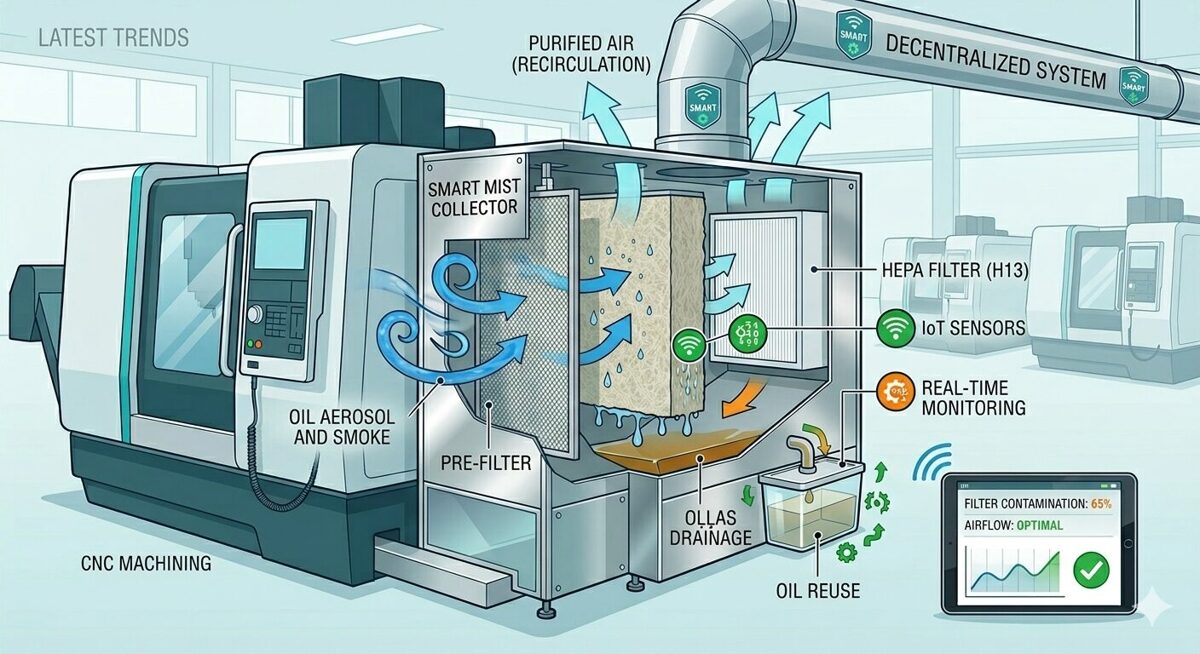 Latest Trends in Combating Oil Aerosols in Manufacturing Workshops
Metalworking requires high precision and productivity, but it also creates significant challenges in maintaining air quality. One of the main issues is oil aerosols generated when using cooling and lubricating fluids in CNC and other metalworking machines. These microscopic particles can negatively affect employee health, equipment longevity, and the overall working environment.
Today, air purification technologies are rapidly evolving, offering more efficient, cost-effective, and environmentally friendly solutions.
1. Smart Filtration Systems and Automation
The new generation of oil mist collectors is equipped with sensors and automatic control functions. They can:
-
adjust performance according to pollution levels;
-
notify operators about filter wear;
-
optimize energy consumption.
This approach reduces downtime risks and ensures stable air quality without manual adjustments.
2. Multi-Stage Filtration Technologies
For effective oil aerosol removal, combined filtration systems are increasingly used:
-
mechanical pre-filtration for larger particles;
-
coalescing filters to combine oil droplets;
-
fine filtration elements for final air polishing.
Such systems can achieve more than 99% contaminant capture efficiency, significantly improving the working environment.
3. Recirculation of Cleaned Air
Energy efficiency is one of the main goals of modern industry. Advanced solutions allow companies to:
-
return cleaned air back into the workshop;
-
reduce heating and ventilation costs;
-
maintain a stable indoor climate.
This is especially important in colder regions, where heat loss can result in substantial expenses.
4. Sustainable Filtration Materials
Manufacturers are increasingly using:
-
long-life filtration materials;
-
recyclable components;
-
designs that allow easy maintenance.
This reduces operational costs and minimizes waste.
5. Integration with Occupational Safety Systems
Air quality monitoring is now integrated into overall workplace safety systems. This includes:
-
real-time pollution monitoring;
-
automated alerts;
-
improved employee health protection.
Clean air is no longer an added benefit — it is a production standard.
Practical Solution: PrecitoniX OMM 150 Oil Mist Collector
As an example of a modern and efficient solution, the PrecitoniX OMM 150 Oil Mist Collector, available from UDBU, demonstrates how compact systems can deliver powerful performance in metalworking environments.
Manufactured by PrecitoniX, this model is designed for metalworking machines that require compact yet highly efficient oil aerosol removal. It provides:
-
effective oil mist extraction directly from the machine’s working area;
-
multi-stage filtration;
-
simple installation and maintenance;
-
improved workplace air quality and equipment protection.
More information about the product:
https://www.udbu.eu/produkti/item/instrumenti/precitonix-omm-150-ellas-miglas-savacejs/
Conclusion
Combating oil aerosols in modern metalworking facilities is based on:
-
automated and intelligent filtration systems;
-
multi-stage air purification;
-
energy-efficient air recirculation;
-
sustainable materials;
-
integrated occupational safety strategies.
By implementing modern oil mist collection systems, companies not only improve working conditions but also reduce operating costs and enhance long-term production efficiency.