
The Role of Coolants in Machining Ultra-Hard Carbide Materials
 The Role of Coolants in Machining Ultra-Hard Carbide Materials
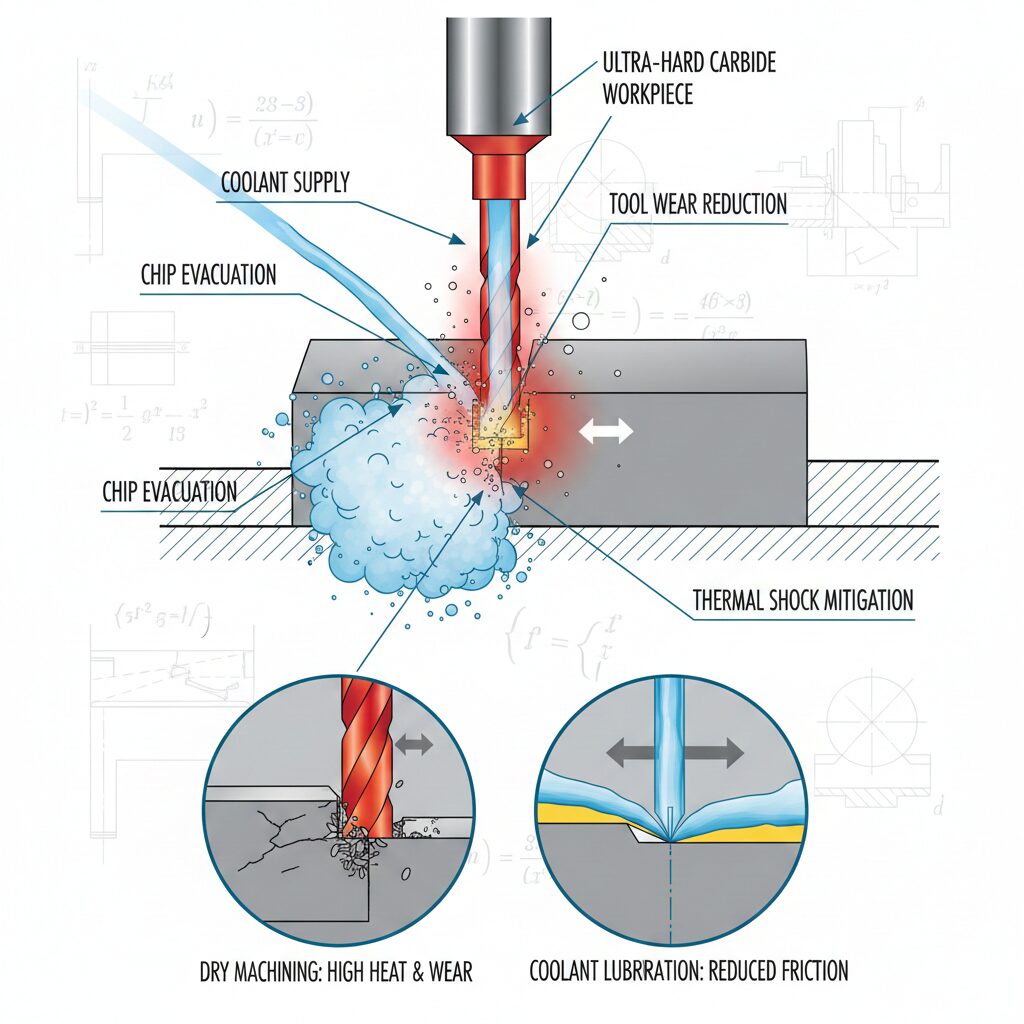
Ultra-hard carbide materials (tungsten, tantalum, and titanium carbides, cermets, and carbide- and nitride-based composites) are widely used in tool manufacturing, aerospace, energy, and mechanical engineering industries. Their key advantages include high hardness, wear resistance, and thermal stability. However, these same properties make machining extremely challenging. In this context, coolants and lubricants play a critical role.
Characteristics of Machining Ultra-Hard Carbides
When machining ultra-hard carbide materials, the following challenges arise:
-
extremely high temperatures in the cutting zone (800–1200 °C and higher);
-
accelerated tool wear;
-
formation of microcracks and edge chipping;
-
risk of thermal stresses and tool failure;
-
unstable surface quality.
Effective cooling helps partially or fully mitigate these issues.
Main Functions of Coolants
1. Heat removal
Coolants reduce the temperature in the cutting zone, preventing:
-
overheating of the cutting edge;
-
thermal damage to the tool;
-
structural changes in the workpiece material.
This is especially important for carbides and ceramics sensitive to thermal shock.
2. Friction reduction
The lubricating effect:
-
lowers the coefficient of friction between tool and workpiece;
-
reduces cutting forces;
-
improves process stability.
As a result, the risk of cutting edge chipping is reduced.
3. Extended tool life
Properly selected coolants:
-
slow down abrasive and diffusion wear;
-
reduce oxidation at high temperatures;
-
significantly extend the service life of expensive tools.
4. Improved surface quality
Coolants help to:
-
reduce surface roughness;
-
minimize microcracks;
-
ensure stable dimensional accuracy.
This is critical for precision and tooling components.
Types of Coolants and Their Applications
Water-based coolants
Advantages:
-
high heat capacity;
-
efficient heat removal;
-
versatile application.
Disadvantages:
-
corrosion risk;
-
limited lubricating properties.
Used mainly for grinding and moderate cutting conditions.
Oil-based coolants
Advantages:
-
excellent lubricating properties;
-
effective reduction of friction and wear.
Disadvantages:
-
lower cooling efficiency;
-
higher cost and disposal requirements.
Applied in finishing operations and low feed rates.
Minimum Quantity Lubrication (MQL)
-
very small amount of oil supplied as an aerosol;
-
reduced thermal shock;
-
environmentally friendly.
Effective for milling and high-speed machining.
Cryogenic cooling
Uses liquid nitrogen or CO₂.
Advantages:
-
drastic temperature reduction;
-
minimal tool wear;
-
no contamination.
Limitations:
-
high cost;
-
complex system integration.
Highly effective for machining ultra-hard carbides and composites.
Risks of Improper Coolant Use
Incorrect selection or application of coolants may lead to:
-
thermal shock and tool cracking;
-
uneven cooling;
-
poor surface quality;
-
accelerated machine wear.
It is essential to ensure stable and well-directed coolant delivery directly into the cutting zone.
Modern Trends
-
intelligent coolant delivery systems;
-
hybrid MQL and cryogenic cooling;
-
digital temperature monitoring;
-
thermal process simulation using digital twins.
Practical Recommendations
-
select coolants according to material and cutting parameters;
-
avoid intermittent cooling at high temperatures;
-
monitor coolant cleanliness and concentration;
-
test different cooling strategies on trial parts.
Conclusion
Coolants play a crucial role in machining ultra-hard carbide materials. A properly selected cooling strategy significantly extends tool life, ensures high surface quality, improves process stability, and reduces overall production costs.