
Common Mistakes in Designing Dust Extraction Systems in a Metalworking Workshop
May 29, 2026 at 4:43 pm
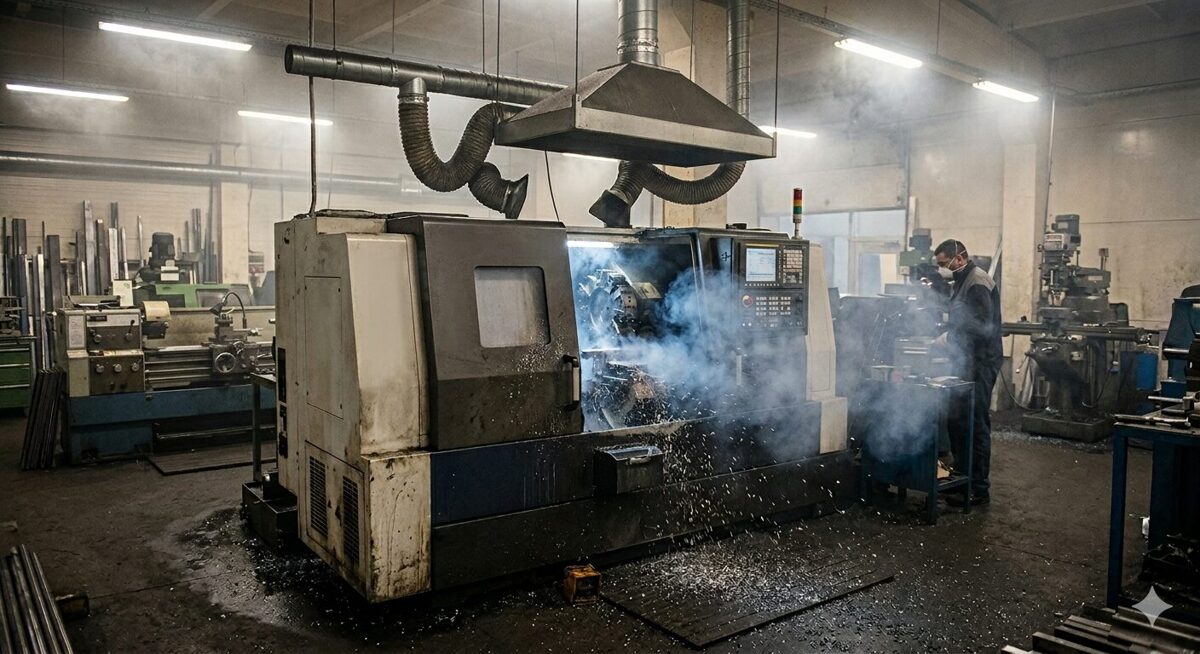 Common Mistakes in Designing Dust Extraction Systems in a Metalworking Workshop
In modern metalworking workshops, dust extraction systems are no longer just an “additional option.” During CNC machine operation, milling, grinding, and turning processes, oil mist, coolant aerosols, and fine metal particles are released into the air. A poorly designed air purification system not only contaminates the workshop but also accelerates equipment wear, worsens working conditions, and increases maintenance costs.
Let us review the most common mistakes made when designing extraction systems in metalworking.
1. Incorrect system capacity calculation
One of the most common mistakes is selecting equipment “by eye” or based only on price. To ensure effective air cleaning, the following must be considered:
- number of machines
- type of processing
- amount of coolant used
- intensity of oil mist formation
- size of the workspace
If system capacity is insufficient, aerosols remain in the air and settle on equipment.
2. Installing the extraction system too far from the pollution source
The longer the ducting and the more bends in the system, the lower the efficiency of oil mist collection. Equipment is often installed where there is space, rather than where it is most effective.
In practice, the best results are achieved with local filtration — when the air cleaner is installed directly next to the machine.
3. Using inappropriate filtration technology
Different metalworking processes generate different types of pollutants. Coarse chips, fine oil mist, and smoke require different filtration technologies:
- mechanical filtration
- coalescence filtration
- centrifugal filtration
- HEPA filtration
Choosing the wrong technology leads to rapid filter clogging and reduced system efficiency.
4. Ignoring maintenance already at the design stage
Systems are often designed without considering future maintenance. As a result:
- filters are difficult to replace
- the system is difficult to clean
- there is no oil drainage
- maintenance requires production shutdown
Modern systems must provide easy access to filters and minimal downtime.
5. One system for all machines without airflow balancing
Connecting multiple CNC machines to a single system without proper airflow calculations is another common mistake. Different machines create uneven loads, so without balancing, some equipment does not receive sufficient air cleaning.
6. Ignoring energy efficiency
Some companies still exhaust cleaned air outdoors even in winter, losing heat and increasing heating costs. Modern systems allow efficient air cleaning and recirculation back into the facility while maintaining safety requirements.
Practical solution for local air cleaning
For metalworking machines where oil mist and coolant aerosols are generated, an effective solution is compact local air purification systems installed directly at the source of contamination.
One such solution is Precitonix OMM 150 Eļļas Miglas Savācējs — an industrial centrifugal oil mist collector for metalworking. The system provides:
- multi-stage filtration
- up to 99% contaminant removal
- compact installation next to the machine
- low noise level
- coolant return to the system
- reduced equipment and air pollution in the workshop
Conclusion
A properly designed extraction system directly affects production safety, equipment lifespan, and machining quality. Most problems arise not from equipment quality, but from design mistakes.
Local air cleaning, proper filtration selection, and modern equipment can significantly reduce oil mist concentration and improve working conditions in the metalworking workshop.