
7 Metalworking Operations That a Cobot Can Take Over as Early as Tomorrow
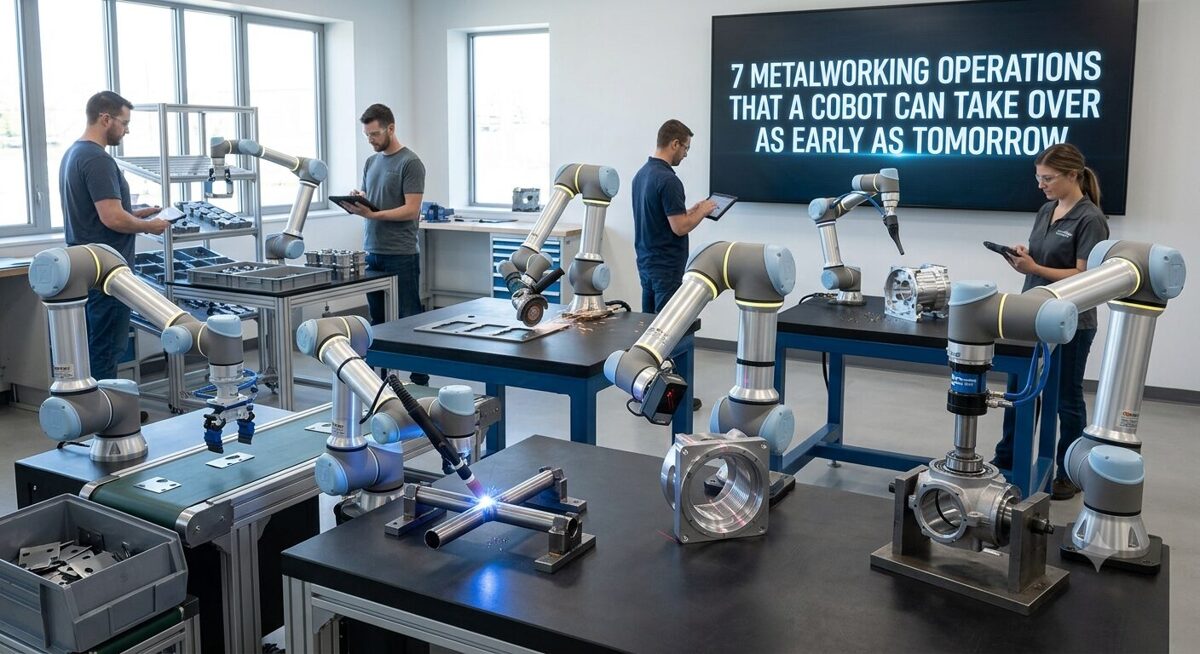 7 Metalworking Operations That a Cobot Can Take Over as Early as Tomorrow
The shortage of skilled workers, increasing quality requirements, and the need to improve productivity are pushing metalworking companies to search for new automation solutions. One of the most accessible and effective solutions today is cobots—collaborative robots that can safely work alongside humans and quickly adapt to different tasks.
Unlike traditional industrial robots, cobots do not require complex infrastructure or long implementation times. Many operations can be automated within just a few weeks. Let’s look at seven metalworking operations that a cobot can take over as early as tomorrow.
1. CNC Machine Loading and Unloading
CNC machine tending is one of the most common applications for cobots. A robot can automatically load raw blanks and unload finished parts from turning, milling, or grinding machines.
Benefits:
reduced machine downtime;
possibility to run night shifts;
consistent and precise part handling;
increased overall production efficiency.
This is especially effective in serial production, where operators repeatedly perform the same actions.
2. Part Palletizing and Packaging
After machining, parts must be sorted, placed into containers, or arranged on pallets. This process is time-consuming and physically repetitive.
A cobot can:
arrange parts according to a predefined pattern;
sort products by type;
prepare goods for shipment;
automatically track produced quantities.
3. Welding of Metal Structures
Modern cobots are successfully used in MIG/MAG and TIG welding processes. Easy programming makes them suitable even for small batches and frequently changing production.
Key advantages:
consistent weld quality;
reduced defect rates;
safer working conditions;
ability to operate continuously.
For many companies, robotic welding becomes the first step toward automation.
4. Surface Grinding and Deburring
Metal surface processing is one of the most physically demanding and repetitive operations. In manual work, quality often depends on operator fatigue.
A cobot can perform:
deburring;
edge grinding;
surface polishing;
final finishing.
Constant force and precise motion ensure consistent results for every part.
5. Quality Inspection Using Machine Vision
Equipped with machine vision systems, a cobot can automatically inspect dimensions, shapes, and surface quality of parts.
Automated quality control enables:
early detection of defects;
reduced number of complaints;
faster inspection processes;
objective quality data collection.
This is especially important for manufacturers with high precision requirements.
6. Part Transfer Between Workstations
In many factories, a significant amount of time is spent moving parts between machines.
A cobot can:
transfer parts between work areas;
serve multiple machines simultaneously;
feed intermediate storage buffers;
automate internal logistics.
This allows workers to focus on more complex and value-added tasks.
7. Coating and Surface Treatment
Painting, protective coating application, and similar processes require high precision and repeatability.
Using a cobot ensures:
even material application;
reduced material consumption;
lower defect rates;
improved workplace safety.
It also reduces the influence of human variability on final product quality.
Why Choose a Cobot?
The main advantage of collaborative robots is flexibility. They can be quickly adapted to new products, take up minimal space, and operate safely alongside humans without the need for complex protective fencing.
For metalworking companies, this means starting automation with a single workstation, achieving fast economic results, and gradually scaling automation across the entire production.
Conclusion
Cobots are no longer a future technology—they are already a practical tool for improving manufacturing efficiency. CNC machine tending, welding, grinding, quality inspection, and internal logistics are just some of the processes that can be automated without major infrastructure investments.
Companies that start adopting cobots today gain not only higher productivity but also a significant competitive advantage in a market where speed, quality, and flexibility are becoming decisive factors.
Want to find out which operations in your production can be automated?
UDBU helps companies implement cobots, industrial robots, and automation solutions for metalworking—from process analysis to full integration and training. Learn more about automation here: https://www.udbu.eu/automatizacija/