
5-Axis Machining: Benefits, Drawbacks, and When It Is Truly Necessary
 5-Axis Machining: Benefits, Drawbacks, and When It Is Truly Necessary
Modern manufacturing demands higher precision, faster production, and the ability to produce increasingly complex parts. As a result, 5-axis CNC machining has become the industry standard in sectors such as aerospace, automotive, medical manufacturing, and mold and die production. However, not every component requires 5-axis machining. In this article, we'll explain how it differs from traditional 3-axis machining, explore its key advantages and limitations, and discuss when investing in this technology is truly worthwhile.
What Is 5-Axis Machining?
A standard 3-axis CNC machine moves the cutting tool along three linear axes: X, Y, and Z. The workpiece remains fixed, and machining different surfaces often requires multiple setups and repositioning.
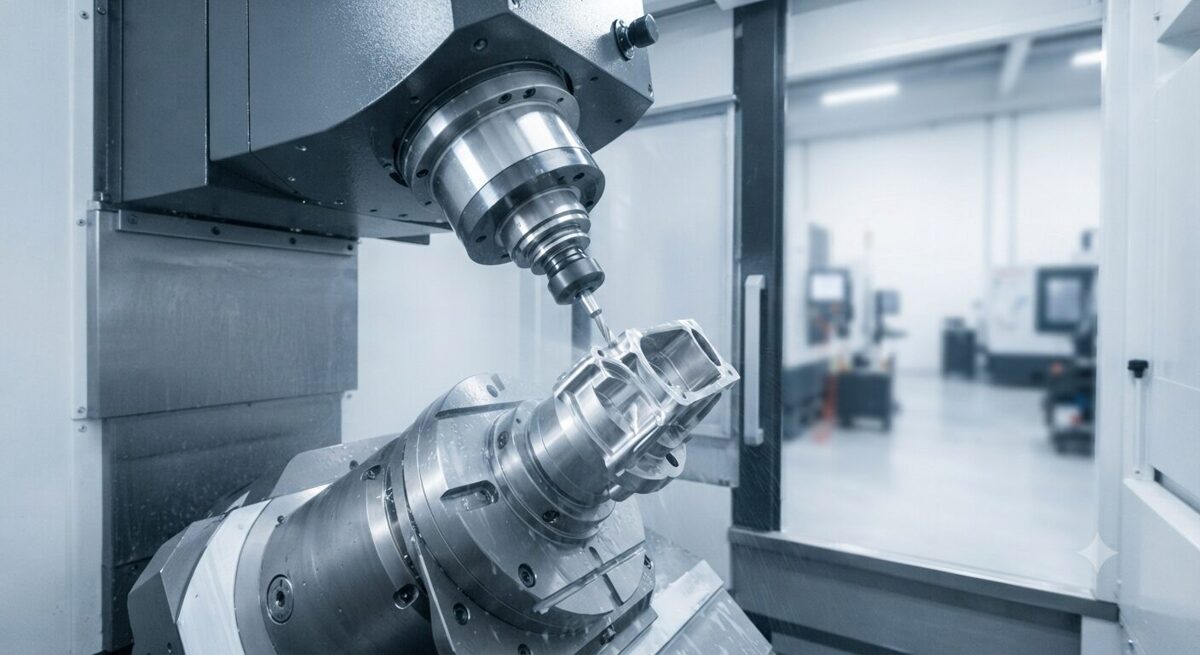
A 5-axis machining center adds two rotational axes, allowing either the workpiece or the cutting tool to rotate during machining. This enables the tool to approach the part from virtually any angle.
As a result, complex components can often be manufactured in a single setup while maintaining exceptional dimensional accuracy across all surfaces.
Key Benefits of 5-Axis Machining
1. Machining Complex Geometries
The greatest advantage of 5-axis machining is its ability to manufacture parts with complex three-dimensional shapes without additional setups.
This capability is particularly valuable in:
Aerospace manufacturing
Power generation
Medical device production
Turbine manufacturing
Mold and die making
2. Improved Accuracy
Every time a workpiece is repositioned, there is a risk of introducing alignment errors.
Since most operations in 5-axis machining are completed in a single setup, positioning errors are minimized, resulting in higher overall accuracy.
3. Reduced Production Time
Although programming is more sophisticated, total production time is often significantly shorter because:
Multiple setups are eliminated.
The workpiece is automatically repositioned.
Secondary operations are reduced.
These time savings become especially noticeable in prototype and low-volume production.
4. Superior Surface Finish
The cutting tool can maintain the optimal angle relative to the workpiece throughout the machining process.
This provides:
Better surface quality
Lower surface roughness
Less manual finishing and polishing
5. Longer Tool Life
A well-planned machining strategy distributes cutting forces more evenly across the cutting edge.
This reduces tool wear, improves machining stability, and extends tool life.
Drawbacks of 5-Axis Machining
Despite its many advantages, 5-axis machining is not the right solution for every application.
Higher Equipment Costs
5-axis CNC machining centers are considerably more expensive than conventional 3-axis machines.
In addition to the machine itself, manufacturers typically require:
Advanced CAD/CAM software
High-performance programming systems
Highly skilled operators and programmers
More Complex Programming
Generating toolpaths for 5-axis machining requires specialized expertise.
Programming errors can result in collisions between the cutting tool, the workpiece, and the machine itself.
Greater Operator Expertise Required
Operating a 5-axis machining center demands in-depth knowledge of:
CNC machining processes
Machine kinematics
Cutting tool selection
Machining strategies
When Is 5-Axis Machining Really Necessary?
5-axis machining delivers the greatest value when manufacturing:
Turbine blades
Impellers
Blisks
Medical implants
Complex molds and dies
Aerospace engine components
Parts with multiple angled or hard-to-reach surfaces
It is also highly beneficial for prototype development and custom manufacturing, where reducing lead times is critical.
When Is 3-Axis Machining Sufficient?
If a part has relatively simple geometry and most machining operations can be performed from a single direction, 5-axis machining may not be economically justified.
For these components, 3-axis CNC machining often provides:
Lower production costs
Simpler programming
High productivity
Cost-effective manufacturing
The most appropriate machining method should always be selected based on the part geometry, required tolerances, production volume, and overall manufacturing costs.
How to Choose the Right Machining Method
Selecting the optimal machining technology typically involves evaluating several factors:
Part complexity
Number of required setups
Accuracy requirements
Material type
Production volume
Target manufacturing cost
A thorough manufacturing feasibility analysis before production begins helps identify the most efficient and cost-effective machining strategy.
Conclusion
5-axis CNC machining offers significant advantages for manufacturing complex, high-precision components while minimizing setups. It can reduce production time, improve surface quality, and increase machining accuracy.
However, it is not a universal solution. For simpler components, traditional 3-axis machining often remains the more economical and practical choice.
Choosing the right machining technology at the planning stage helps optimize manufacturing costs, shorten lead times, and ensure that the finished part meets the required quality standards.