
 Tool Balancing in High-Speed Machining: Impact on Quality and Tool Life
High-speed machining (HSM) places increased demands on the entire manufacturing system. One of the key factors that directly affects machining quality, tool life, and machine longevity is tool balancing.
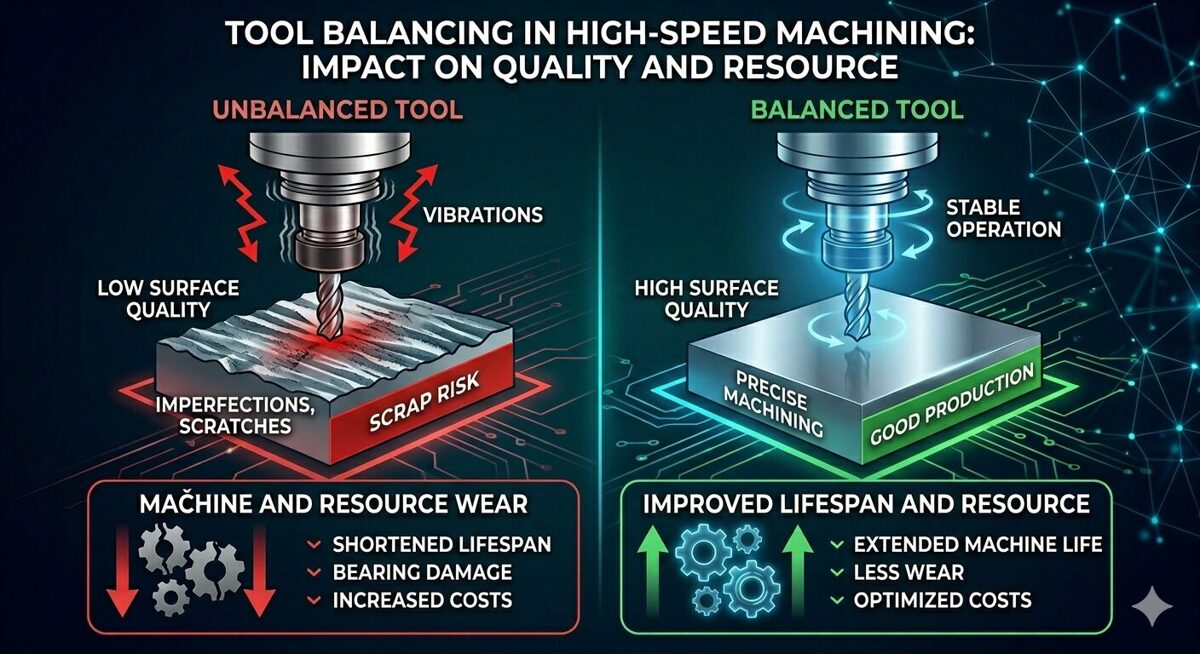
Ignoring this aspect leads to vibrations, accelerated wear, and defects—even when using modern equipment and high-quality tools.
What Is Tool Balancing
Tool balancing is the process of evenly distributing the mass of a rotating tool relative to its axis of rotation.
If the center of mass does not align with the rotation axis, imbalance occurs, generating centrifugal forces and vibrations at high speeds.
Even minimal deviation at high rotational speeds (10,000–30,000 RPM and above) can lead to critical consequences.
Causes of Imbalance
The main sources of imbalance include:
manufacturing inaccuracies of the tool or holder
contamination (chips, coolant, dust)
wear of clamping surfaces
improper tool assembly
material inhomogeneity
spindle or clamping system runout
How Imbalance Affects the Machining Process
1. Reduced Surface Quality
Vibrations cause:
surface waviness
runout marks
increased roughness
2. Accelerated Tool Wear
Imbalance leads to:
uneven load on cutting edges
localized overheating
chipping and microcracks
As a result, tool life is significantly reduced.
3. Increased Load on the Spindle
Vibrations increase:
bearing wear
risk of spindle failure
maintenance frequency
4. Noise and Process Instability
higher noise levels
reduced process repeatability
increased risk of defects
Balancing Grades
Balancing is typically evaluated according to ISO standards (e.g., G2.5, G6.3, etc.).
G6.3 — standard level for general machining
G2.5 — recommended for high-speed machining
G1.0 and above — for ultra-precision operations
The lower the value, the higher the balancing accuracy.
Balancing Methods
1. Static Balancing
suitable for simple tools
considers mass distribution in a single plane
2. Dynamic Balancing
considers mass distribution along the entire tool length
essential for high-speed machining
Practical Methods to Eliminate Imbalance
using balancing machines
tool holders with adjustable mass
adding or removing balancing screws
using precision tool holders (HSK, hydraulic chucks, shrink-fit holders)
Best Practices for Production
To minimize the impact of imbalance:
always clean the tool before installation
check runout and clamping
use high-quality tooling systems
balance the complete assembly (tool + holder)
follow recommended spindle speeds
perform regular inspections
Economic Benefits
Proper balancing delivers measurable advantages:
tool life increase by up to 30–50%
reduction in scrap rates
improved surface quality
lower spindle repair costs
increased overall productivity
Conclusion
Tool balancing is not an optional step but a critical requirement for stable and efficient high-speed machining.
Investing in proper balancing pays off through improved product quality, longer tool life, and reduced operating costs.