
Adaptive Milling Strategies in CAM Systems: Tables, Parameters, and Comparison of Fusion 360, NX, and Mastercam
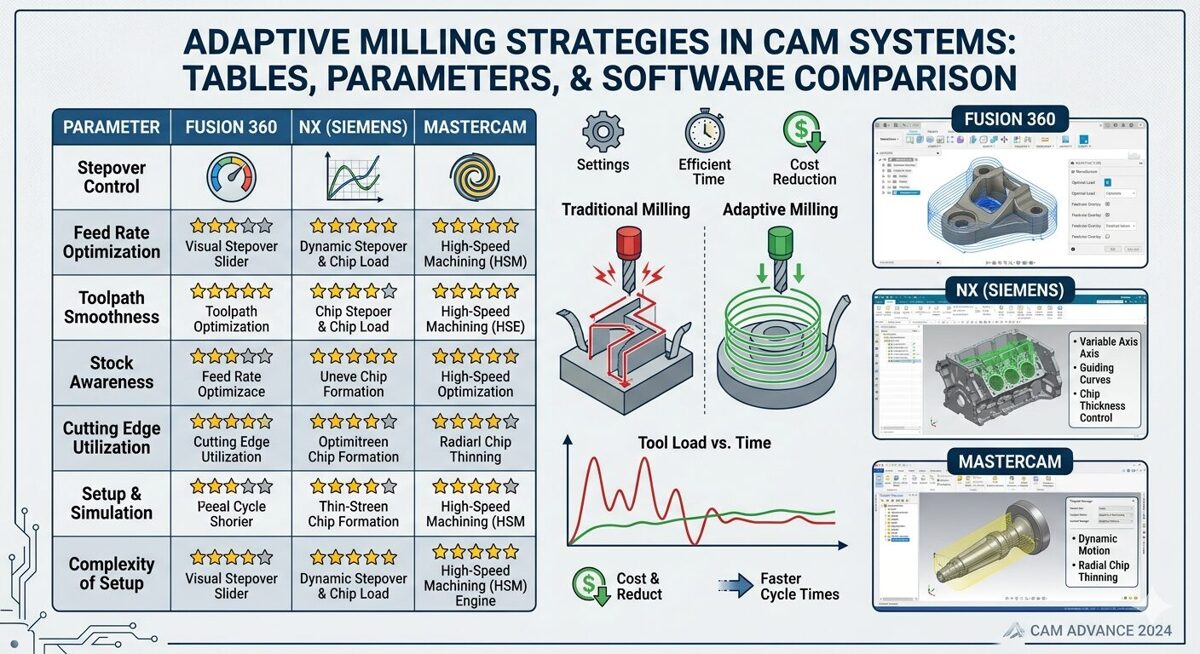 Adaptive Milling Strategies in CAM Systems: Tables, Parameters, and Comparison of Fusion 360, NX, and Mastercam
Introduction
Adaptive milling is one of the key technologies in high-efficiency machining (HEM), enabling productivity increases of 2–5 times by controlling tool load and optimizing toolpaths.
Unlike conventional strategies:
the tool operates with a constant chip thickness
radial load is reduced
axial depth of cut is increased
The result is reduced tool wear, higher speeds, and improved surface quality.
Table 1 — Comparison of CAM Systems for Adaptive Milling
| Parameter | Fusion 360 | Siemens NX | Mastercam |
|---|---|---|---|
| Strategy Type | Adaptive Clearing | Adaptive Roughing | Dynamic Milling |
| Load Control | Automatic | Constant chip load | Dynamic Motion |
| 5-axis Machining | Limited | Full | Full |
| CAD Integration | Built-in | Built-in | Partial |
| Cloud Capabilities | Yes | Partial | No |
| Complexity Level | Low | High | Medium |
Conclusion:
Fusion 360 is suitable for quick adoption and small workshops
Siemens NX is ideal for complex and 5-axis machining
Mastercam offers a balanced, universal solution
Table 2 — Efficiency of Adaptive Milling
| Metric | Conventional Machining | Adaptive Milling | Change |
|---|---|---|---|
| Machining Time | 100% | 20–40% | −60–80% |
| Tool Life | 100% | 150–300% | +50–200% |
| Material Removal Rate | 100% | 200–500% | +100–400% |
| Surface Roughness | Ra 3.2 | Ra 0.8–1.6 | up to −75% |
| Energy Consumption | 100% | 70–85% | −15–30% |
This demonstrates that adaptive milling is significantly more efficient across all key metrics.
Table 3 — Key Parameters for Adaptive Machining
| Parameter | Range | Steel | Aluminum |
|---|---|---|---|
| Radial Depth of Cut (ae) | 5–25% D | 7–12% | 15–20% |
| Axial Depth of Cut (ap) | 1–5D | 2–3D | 3–4D |
| Feed per Tooth | 0.05–0.3 mm | 0.1–0.15 | 0.2–0.25 |
| Cutting Speed | 50–500 m/min | 120–180 | 300–450 |
| Minimum Radius | 0.5–3D | 1–1.5D | 0.5–1D |
Key principle:
a small radial depth (ae) combined with a large axial depth (ap) delivers maximum efficiency.
Table 4 — Recommendations by Material
| Material | Tool | Coating | Recommended CAM System |
|---|---|---|---|
| Carbon Steel | Carbide end mill | TiAlN | NX / Mastercam |
| Stainless Steel | Variable pitch tool | AlCrN | Mastercam |
| Aluminum 6061 | Sharp cutting edge | Uncoated | Fusion 360 |
| Titanium | Reinforced tool | TiAlN + DLC | NX |
| Inconel | Ceramic tool | Al2O3 | NX |
How Adaptive Milling Works
The core principle is maintaining a constant load on the cutting tool.
This is achieved through:
trochoidal toolpaths
automatic feed rate adjustment
geometry-aware toolpath generation
Efficiency formula:
Efficiency = (T_conventional − T_adaptive) / T_conventional × 100%
Strategy Setup in CAM Systems
Fusion 360
Optimal Load: 0.5 mm (for aluminum)
Keep Tool Down: enabled
Stock to Leave: 0.2 mm
Best suited for quick implementation and training.
Siemens NX
ae: 7–12%
ap: 2–3D
AI-assisted parameter optimization
Provides maximum control and precision.
Mastercam
Dynamic Milling
Step: 5–15%
Built-in finishing passes
Well suited for production environments.
Common Mistakes
Excessive ae leading to tool overload
Insufficient ap reducing efficiency
Incorrect feed rates causing vibration
Ignoring machine rigidity
Machine Requirements
Minimum requirements:
rigidity ≥ 50 N/µm
spindle speed ≥ 10,000 rpm
power ≥ 15 kW
Implementation Plan for Businesses
| Stage | Timeline |
|---|---|
| Audit | 1–2 months |
| Training | 2 months |
| Pilot Project | 3–4 months |
| Scaling | up to 6 months |
Conclusion
Adaptive milling provides:
significantly reduced machining time
extended tool life
improved surface quality
System selection:
small workshops — Fusion 360
complex parts — Siemens NX
general-purpose manufacturing — Mastercam