
Sheet Metal Bending: Common Mistakes and How to Avoid Them
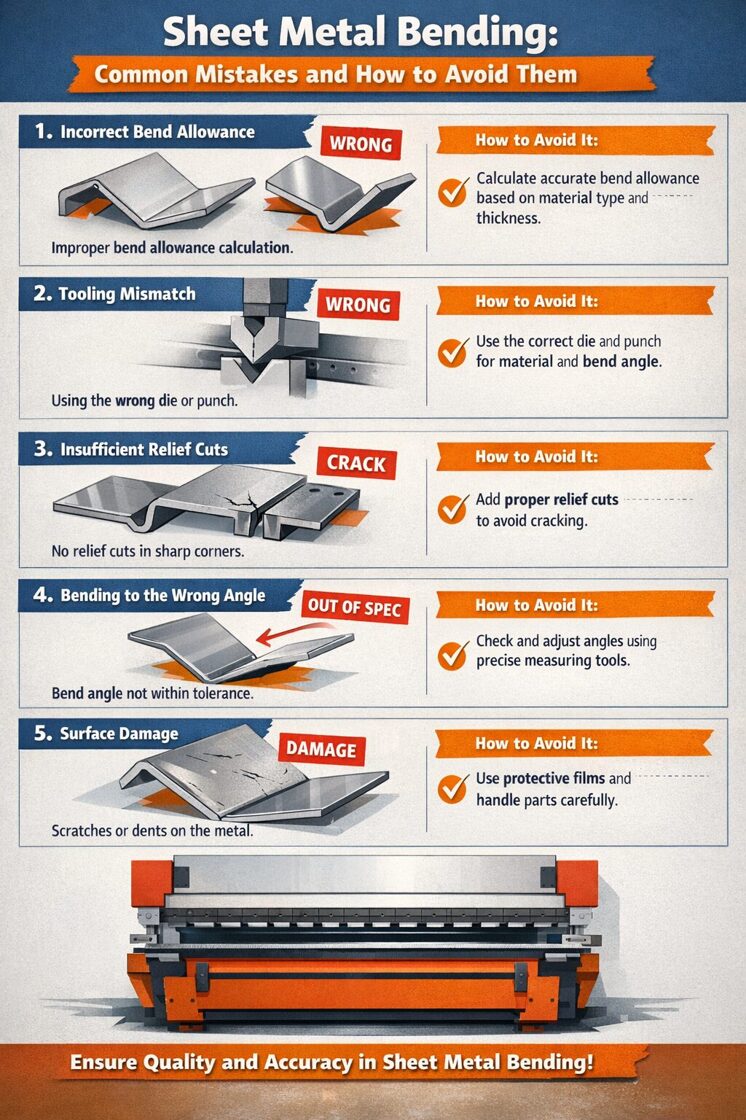 Sheet Metal Bending: Common Mistakes and How to Avoid Them
Introduction
Sheet metal bending is one of the most important processes in metalworking, widely used in the production of enclosures, structural components, and machinery parts. Despite its apparent simplicity, errors during the bending stage are common and can lead to defects, increased costs, and production delays.
In this article, we will review the most common sheet metal bending mistakes and practical ways to avoid them — especially relevant for companies operating in Latvia.
What is Sheet Metal Bending
Bending is a metal forming process where the material is plastically deformed without breaking, allowing it to take a desired shape.
The most common methods include:
CNC press brake bending
V-bending
U-bending
Air bending
Common Mistakes and How to Avoid Them
1. Incorrect Bend Radius Selection
Problem:
A radius that is too small can cause cracks, especially in stainless steel and aluminum.
Solution:
Follow the minimum bend radius for the material
Use the rule: radius ≥ material thickness
Verify material properties in advance
2. Ignoring Grain Direction
Problem:
Bending against the rolling direction increases the risk of cracking.
Solution:
Always consider the grain direction
Bend along the grain when possible
Specify it in technical drawings
3. Errors in Flat Pattern Calculation
Problem:
Incorrect blank length results in parts that do not meet specifications.
Solution:
Use the K-factor
Apply CAD/CAM software
Perform test bends
4. Springback Effect
Problem:
After bending, the material partially returns to its original shape.
Solution:
Apply angle compensation
Use accurate bending parameters
Perform calibration if necessary
5. Incorrect Tool Selection
Problem:
Improper tooling leads to surface defects and dimensional inaccuracies.
Solution:
Select tools according to material and thickness
Consider bend angle
Monitor tool wear regularly
6. Surface Damage
Problem:
Scratches and dents, especially critical for visible parts.
Solution:
Use protective films
Keep equipment clean
Use coated tooling
7. Machine Overloading
Problem:
Exceeding machine capacity can damage equipment and cause defects.
Solution:
Calculate bending force in advance
Consider material properties and length
Use CNC-based calculations
Sheet Metal Bending in Latvia
In Latvia (Riga, Liepaja, Daugavpils), customers typically expect:
high precision
fast turnaround times
competitive pricing
Reducing errors in bending directly impacts production efficiency, cost control, and overall competitiveness.
Practical Recommendations
To minimize errors:
Use modern CNC equipment
Automate calculations
Perform test bends
Train operators
Implement quality control processes
Conclusion
Sheet metal bending is not just a mechanical operation but a precise engineering process. Most errors can be prevented at the design and preparation stage.
Companies in Latvia that optimize their bending processes gain a strong competitive advantage through reduced waste, lower costs, and higher product quality.
Looking for reliable sheet metal bending equipment? Explore CNC press brakes and find the right solution for your production: