
Magnetic Abrasive Finishing: Principles and Application Areas
 Magnetic Abrasive Finishing: Principles and Application Areas
What is Magnetic Abrasive Finishing (MAF)
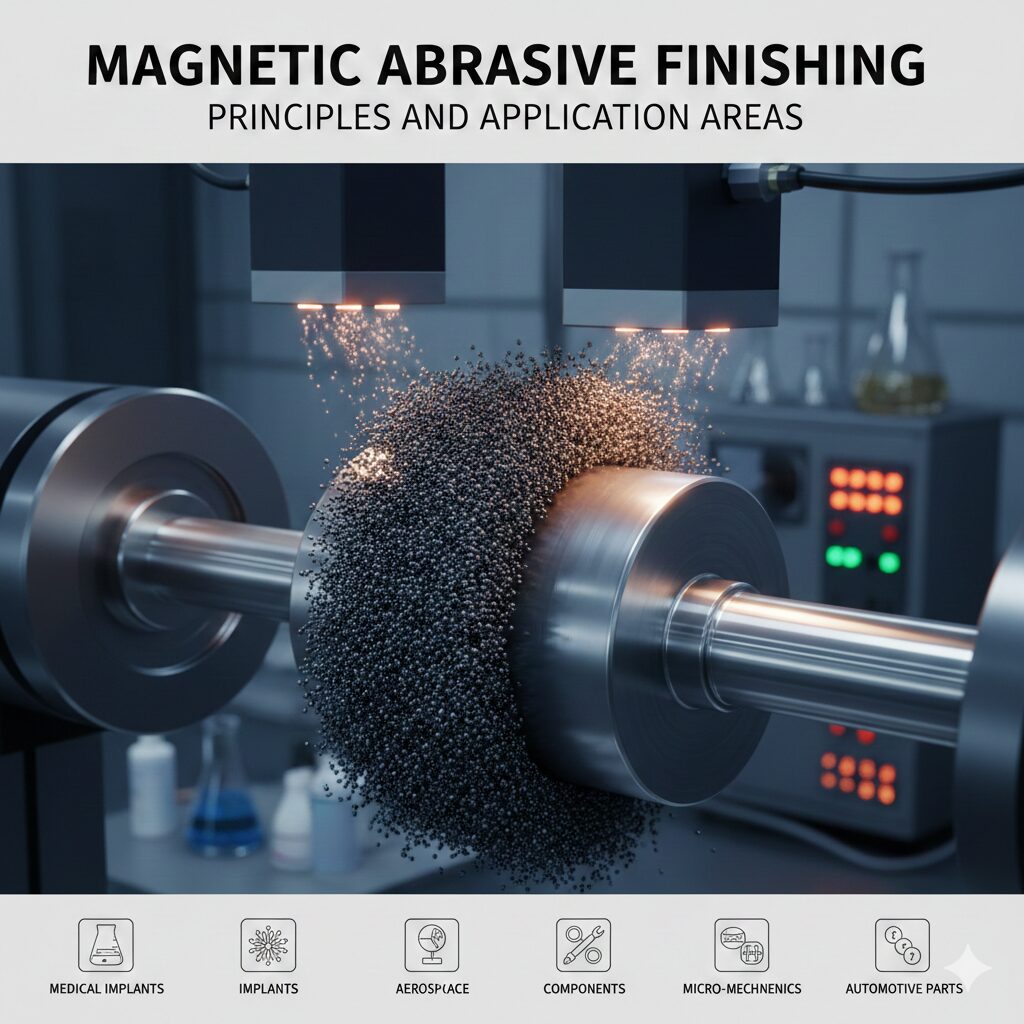
Magnetic Abrasive Finishing (MAF) is a high-precision surface finishing method in which a magnetic field controls the abrasive tool. A magnetic field is created in the working zone, forming a so-called magnetic abrasive brush made of ferromagnetic particles and abrasive grains. This flexible brush gently acts on the surface, removing micro-irregularities and surface defects.
The method is particularly effective for internal channels and complex geometries where conventional machining is difficult.
Operating Principle
The MAF process is based on the interaction of three components:
-
Magnetic field – generated by permanent magnets or electromagnets.
-
Magnetic abrasive powder – mixture of ferromagnetic particles and abrasives (Al₂O₃, SiC, diamond).
-
Relative motion – ensures material removal.
Particles align in chains under the magnetic field, forming an elastic working zone adaptable to surface geometry.
Tasks Solved by MAF
-
Surface roughness reduction to Ra 0.01–0.05 μm
-
Micro-burr removal
-
Polishing of internal channels
-
Improvement of fatigue strength
-
Surface preparation before coating
Application Areas
Aerospace, medical manufacturing, automotive industry, mold and die production.
Advantages
-
Complex geometry processing
-
Minimal thermal impact
-
High repeatability
-
No rigid tool contact
-
Automation capability
Limitations
-
Not suitable for heavy material removal
-
Requires precise magnetic field control
-
High equipment cost
Future Development
-
Integration into automated lines
-
Hybrid technologies (MAF + electrochemical finishing)
-
Intelligent parameter control
-
Finishing of additively manufactured parts