
Implementation of Digital Twins for Production Line Optimization
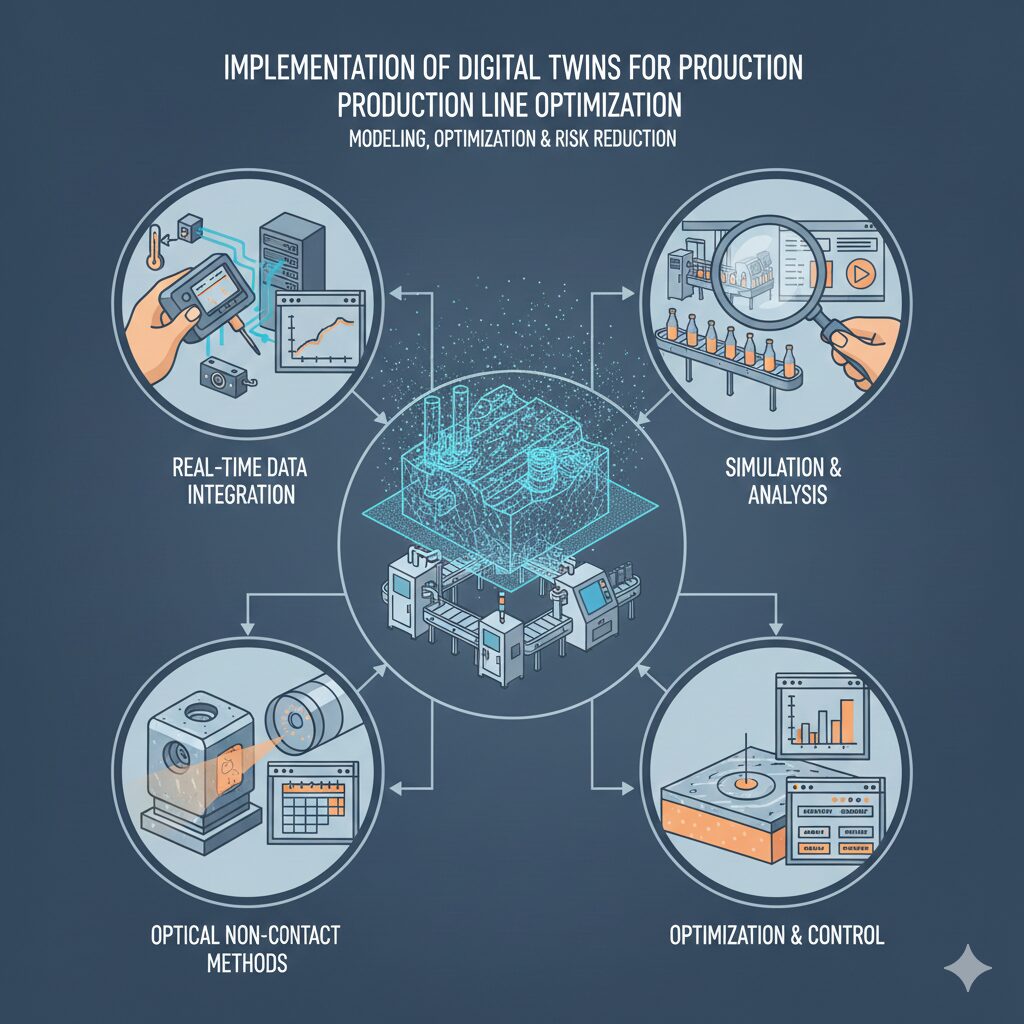 Implementation of Digital Twins for Production Line Optimization
Introduction
Modern manufacturing increasingly faces the challenge of improving efficiency, reducing costs, and quickly adapting to changing market demands. One of the most promising tools for addressing these challenges is the digital twin. Its implementation allows production lines to be modeled and optimized before physical changes are made, significantly reducing risks and expenses.
What Is a Digital Twin
A digital twin is a virtual model of a physical object, process, or an entire production line that:
-
accurately reflects the real condition of equipment,
-
is updated using data from sensors and control systems,
-
enables simulation and predictive analysis.
Why Digital Twins Are Needed in Production Lines
Digital twins help to:
-
identify bottlenecks in production flow,
-
optimize equipment utilization,
-
reduce machine downtime,
-
improve product quality,
-
predict equipment wear and failures.
Key Application Areas
1. Production Flow Optimization
A digital twin enables simulation of:
-
operation sequences,
-
cycle times,
-
workpiece and finished-part logistics.
2. Predictive Maintenance
Based on sensor data, the digital twin:
-
monitors vibration, temperature, and load,
-
predicts component wear,
-
enables maintenance planning before failures occur.
3. Machining Parameter Optimization
For CNC machines, digital twins are used to:
-
select optimal cutting parameters,
-
analyze vibration and deformation,
-
reduce tool wear.
4. Personnel Training
A virtual production line model can be used for:
-
training operators and engineers,
-
simulating emergency scenarios,
-
reducing errors during new process implementation.
Stages of Digital Twin Implementation
-
Data collection and structuring
-
Creation of a virtual model
-
Integration with MES, SCADA, and ERP systems
-
Analysis and continuous optimization
Practical Benefits
-
reduction of equipment downtime by 20–30%,
-
improved Overall Equipment Effectiveness (OEE),
-
lower maintenance costs,
-
faster introduction of new products,
-
increased transparency of production processes.
Conclusions
Digital twins are becoming a key element of industrial digital transformation. When properly implemented, they enable data-driven decision-making, optimize production lines, and significantly enhance a company’s competitiveness.