
Laser Cutting Machine Drives: Rack and Pinion, Ball Screw, Linear Motor or Galvo Head — Which Is Right for Your Production?
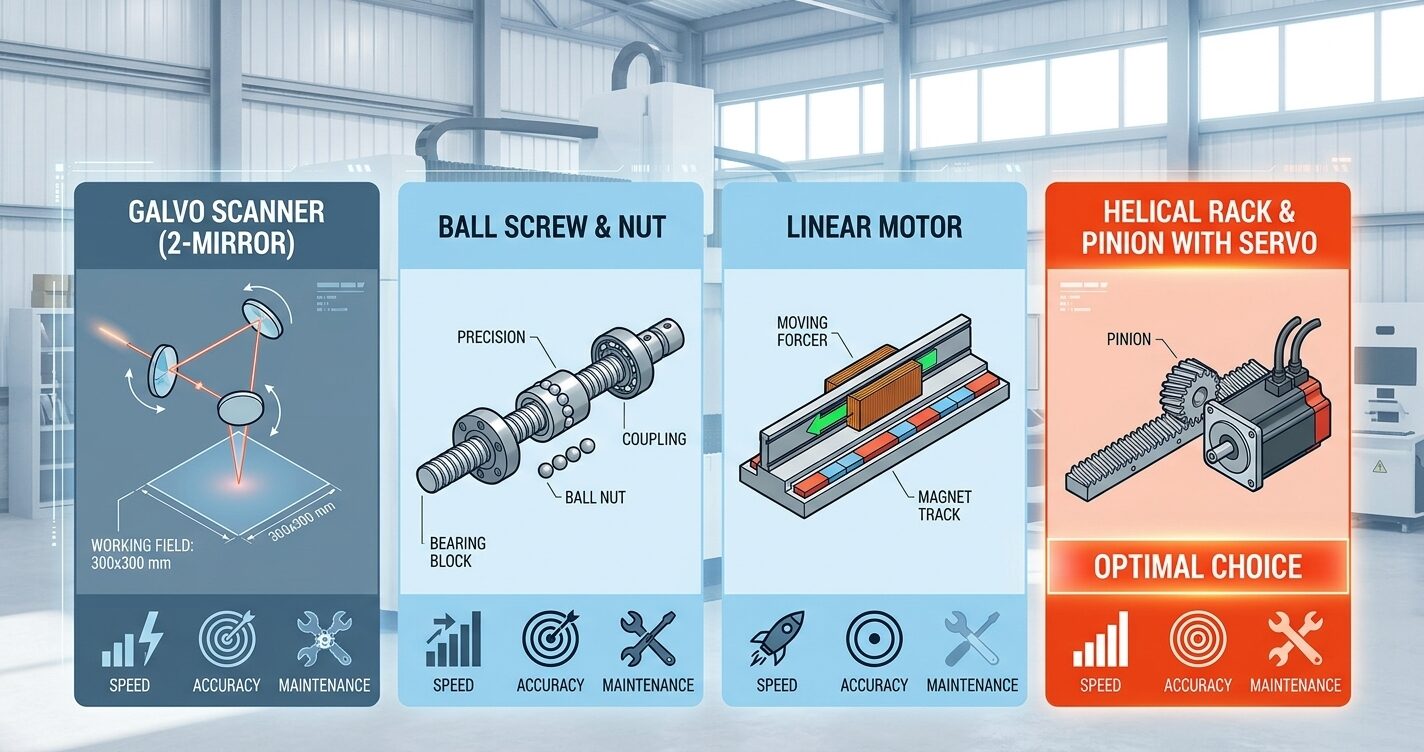
1. Galvanometer head (galvo scanner)
The beam is deflected by two mirrors mounted on galvanometer motors, and an f-theta lens focuses it within the working field. The mechanics barely move — only the lightweight mirrors do — so speed is enormous: metres per second and instant changes of direction.
Advantages:
- maximum speed on small contours;
- ideal for marking, engraving, cleaning, welding and micro-cutting of thin materials;
- no wear on axis mechanics.
The main limitation is the working field. It is defined by the lens and in practice ranges from 100×100 to about 300×300 mm. The larger the field, the larger the spot and the lower the energy density — not suitable for cutting metal thicker than 1 mm.
An important nuance: a galvo head is not an alternative to a gantry, but a tool that can be mounted on one. It can even be carried by a rack drive: the gantry moves the scanner across a large sheet, and the scanner rapidly processes each 300×300 field. This is how marking and cleaning systems for large parts work. So the question “galvo or rack?” really means “galvo on what?”
2. Ball screw
A servo motor turns a screw along which a nut with recirculating balls travels. A machine-building classic: CNC milling and turning centres, positioning tables.
Advantages:
- high positioning accuracy (around ±0.005–0.01 mm on short travels);
- high rigidity and self-locking;
- excellent for short axes.
Drawbacks for laser cutting:
- length limit. A long screw starts to whip at high speed, so on travels of 3–4 m and more speed has to be reduced. A 3000×1500 or 6000×2000 bed is no longer ball-screw territory;
- traverse speed is usually lower than with a rack (tens of m/min versus 100+);
- sensitive to dust and slag — there is plenty of both in a laser cutting zone, and the screw wears;
- replacing a long screw is expensive.
Where a ball screw makes sense in a laser: the Z axis of the cutting head, small precision machines for small parts, jewellery and micro-machining.
3. Linear (magnetic) motor
A direct drive with no transmission: the moving part with coils “rides” over a track of permanent magnets. No backlash, no mechanical wear, accelerations up to 3–5 G.
Advantages:
- maximum dynamics and smoothness;
- high accuracy without mechanical backlash;
- no rubbing parts in the transmission itself.
Drawbacks that are mentioned less often:
- price. The drive costs significantly more than rack and pinion, and this shows in the machine price;
- magnets attract metal dust and fine scale. In metal laser cutting this is a real operating problem — careful protection and regular cleaning are needed;
- heat. The motor generates heat and needs a cooling circuit, otherwise gantry geometry suffers;
- no self-locking on power loss — separate brakes are required;
- repairs and spare parts are more expensive, service is more complex.
The key question — does it pay off? Metal cutting speed is limited by laser power and sheet thickness, not by the drive. On 5–10 mm sheet the head moves at a few metres per minute, and 5 G of acceleration simply goes unused. The linear motor's advantage only shows on thin sheet with many small contours — and even then it rarely justifies the price difference for a typical manufacturer.
4. Rack and pinion
A servo motor drives a pinion through a precision gearbox, and the pinion runs along a helical rack. This is the drive used on most modern fiber lasers for sheet and tube cutting.
Advantages:
- unlimited travel length — the rack is joined in sections, so 3, 4, 6 m beds and longer are no problem;
- high speed: traverse of 100–170 m/min, accelerations of 1.5–2 G and more — more than enough for real cutting;
- accuracy for metal cutting: positioning around ±0.03–0.05 mm, repeatability around ±0.02–0.03 mm with a quality rack, gearbox and proper setup;
- resilience to workshop conditions: far less sensitive to dust and scale than a ball screw or magnets — bellows covers and lubrication are enough;
- low-cost, straightforward maintenance: lubrication, backlash checks and, if needed, replacing a pinion or a rack section;
- an affordable machine price with productivity limited by laser power rather than mechanics.
Drawbacks:
- regular automatic lubrication is required;
- accuracy is lower than a ball screw on short travels — but for sheet cutting this is not critical: the kerf itself is 0.1–0.3 mm wide.
Comparison at a glance
Parameter | Galvo head | Ball screw | Linear motor | Rack and pinion |
|---|---|---|---|---|
Working field / travel | up to ~300×300 mm | up to 3–4 m without losses | any | any |
Speed | very high (within field) | medium | very high | high |
Accuracy | high within field | very high | very high | sufficient for cutting |
Sensitivity to dust and scale | low | high | high (magnets) | low |
Cost | medium | medium | high | optimal |
Maintenance | simple | medium | complex, expensive | simple |
Best use | marking, cleaning, welding | Z axis, small machines | high-dynamic lines on thin sheet | sheet and tube cutting |
Conclusion: why rack and pinion
For laser cutting of sheet and tube, rack and pinion offers the best balance of speed, accuracy, reliability and price:
- galvo head — an excellent tool, but for marking and cleaning, and it still has to be carried by something;
- ball screw — accurate, but unsuitable for long axes and sensitive to dirt; its place is the Z axis and small machines;
- linear motor — high-tech, but expensive, needs cooling and does not get along with metal dust, and its dynamic advantage rarely turns into real money;
- rack and pinion — works on beds of any size, withstands workshop conditions, is simple to maintain and delivers accuracy with margin to spare.
In practice the best machines use a combination: rack and pinion on the X and Y axes, a ball screw on the Z axis, and for marking tasks a galvo head on a separate module.
Let us match a laser to your task
UDBU supplies and services laser cutting machines for sheet and tube in Latvia, Lithuania and Estonia. We will recommend a configuration for your thicknesses, volumes and part sizes, show the machine in operation and calculate the payback.
Contact us: [email protected] · Latvia +371 68688313 · Lithuania +370 66106190 · Estonia +372 6346313