
Can a CNC Machine Process a Crankshaft and Camshaft? A Practical Test of Holzmann Equipment
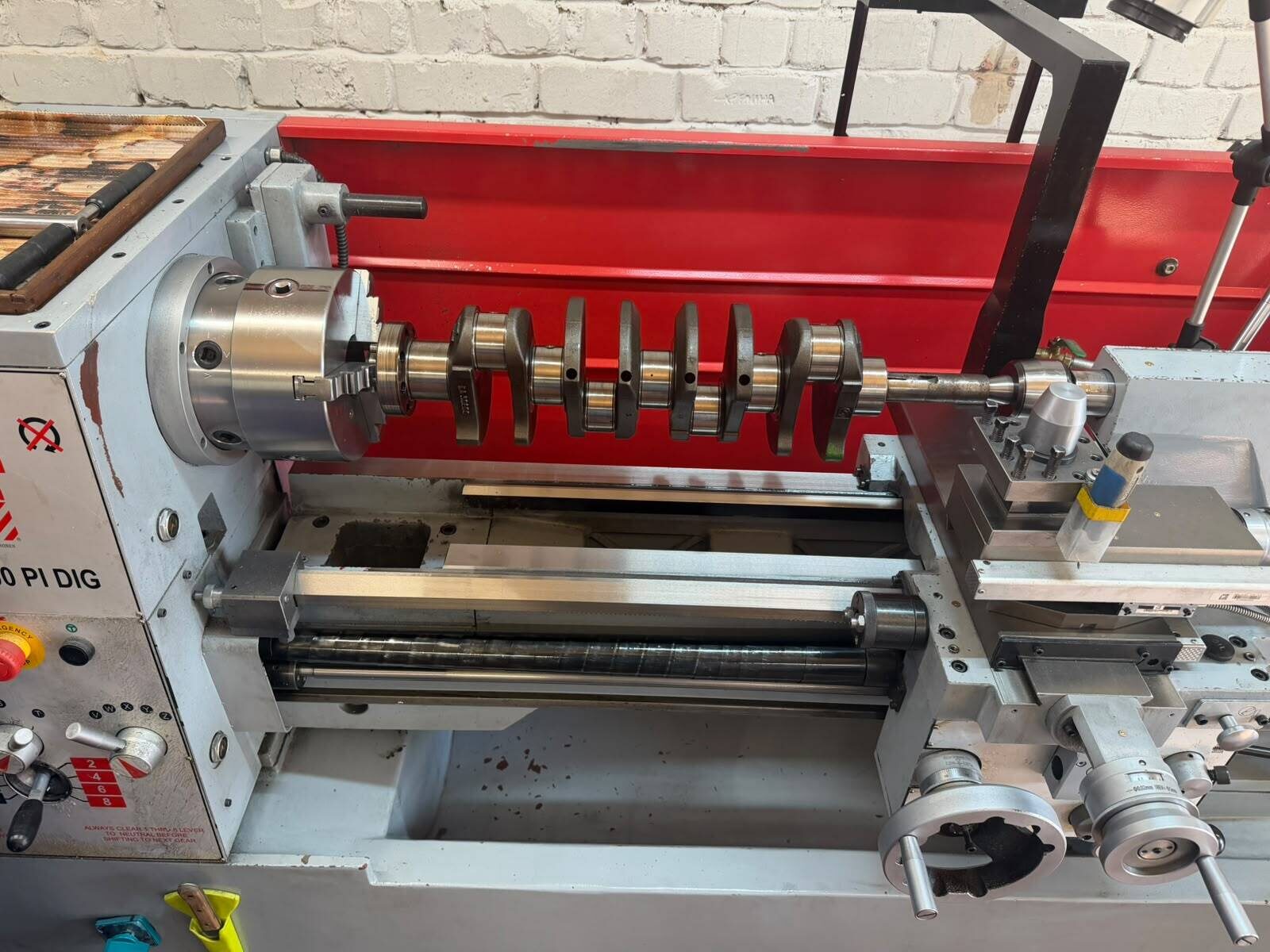
Machining complex metal parts on CNC equipment is often considered a task reserved for large industrial machines. This is especially true when working with components featuring complex geometries, such as crankshafts and camshafts.
But is a large, specialised machining centre really always necessary for these applications?
We decided to find out in practice. We used carefully selected Holzmann equipment, suitable tooling and our own experience in production process preparation.
The results of the test showed that with the right equipment and a properly planned machining process, it is possible to machine complex components using CNC technology.
Why Are Crankshafts and Camshafts Considered Complex Parts?
At first glance, a crankshaft or camshaft may appear to be simply a metal component that can be mounted in a machine and processed according to a program. In practice, the situation is considerably more complicated.
The geometry of these components includes multiple sections and working surfaces that differ in shape, diameter, position and accuracy requirements.
A crankshaft presents an additional challenge because some of its journals are offset from the main axis. In the case of a camshaft, the main difficulty is the cam profile and the need to reproduce its geometry accurately.
As a result, the final outcome depends on much more than the CNC machine itself.
Equally important are:
- correct workpiece fixturing;
- accurate positioning and workpiece referencing;
- appropriate cutting tool selection;
- suitable cutting parameters;
- CNC program preparation;
- the correct machining sequence;
- sufficient rigidity of the machine-fixture-workpiece system;
- the experience and skills of the operator.
It is the combination of these factors that determines how complex a component can be successfully machined on a particular CNC machine.
Can a Crankshaft Be Manufactured Using CNC?
The short answer is yes — but not on every CNC machine and not without careful process planning.
A crankshaft is a good example of a component where CNC technology can provide significant advantages. CNC equipment can perform repeatable operations according to predefined coordinates, which is particularly important when manufacturing parts with complex geometry.
The key is to organise the entire machining process correctly.
It is not enough simply to load a 3D model into the control system. The machining process requires clearly defined workpiece references, positioning points, toolpaths, machining sequences and a suitable workholding solution.
During our practical test, the technological approach proved to be one of the most important factors influencing the final result.
Properly selected equipment combined with professional production preparation makes it possible to tackle machining tasks that may initially appear too demanding for a machine of this class.
What About a Camshaft?
The situation with a camshaft is similar.
The main challenge is the cam profile. It is not a conventional cylindrical surface, so the required geometry must be reproduced accurately.
CNC technology makes it possible to program complex tool movements and repeat the same trajectory with a high degree of accuracy and consistency.
However, the machine itself is only one part of the overall system.
To achieve a quality result, it is necessary to consider:
- the original geometry of the component;
- the workpiece material;
- the required accuracy;
- the cutting tool being used;
- workholding rigidity;
- machining parameters;
- the characteristics of the CNC program.
This is why two visually similar machining tasks can have completely different equipment requirements.
What Did Our Practical Test Show?
The capabilities of a machine can be evaluated theoretically based on its technical specifications. In practice, however, what matters much more is how the equipment performs when solving a real production task.
That is why we conducted our own practical test using Holzmann equipment to evaluate its suitability for machining a component with complex geometry.
During the test, we evaluated not only the machine itself, but the entire technological chain:
equipment → workholding → tooling → programming → setup → machining → result.
It was precisely this comprehensive approach that allowed us to achieve a positive result.
The test demonstrated that with the right configuration and properly prepared machining process, CNC equipment can be used for more than standard operations and relatively simple components.
It can also be used to tackle more complex manufacturing tasks.
Why Isn't a Good CNC Machine Enough on Its Own?
This is one of the key conclusions from our test.
When selecting equipment, attention is often focused primarily on motor power, working area dimensions, the number of axes and other technical specifications.
However, even a very capable machine cannot compensate for weaknesses in the machining process.
Imagine two identical machines. On one, an experienced specialist has selected the correct cutting tool, established the workpiece references, prepared the CNC program and organised the workholding correctly. The second machine has been set up without taking the specific requirements of the operation into account.
The results can be significantly different.
Therefore, when selecting CNC equipment, it is important to ask not only:
“Which CNC machine should we buy?”
but also:
“What production task do we want to solve with it?”
The Role of Holzmann Equipment
Holzmann offers a range of equipment for metalworking, including CNC lathes and milling machines. The manufacturer's range includes, for example, CNC milling machines and CNC lathes designed for different machining applications.
However, the selection of a specific model should always begin not with the machine name, but with the requirements of the production process.
First, it is necessary to determine:
- what components will be manufactured;
- which materials will be processed;
- the dimensions and weight of the workpieces;
- the required accuracy;
- the required number of axes;
- the machining operations involved;
- the required production output;
- automation requirements;
- the capabilities of the existing tooling and workholding systems.
Only then is it possible to select equipment that genuinely matches the production task.
CNC Machining of Complex Parts — What Matters Most?
Our test once again demonstrated a simple principle: machining a complex component is not a task for a machine alone — it is a task for the entire production system.
Several factors are particularly important.
1. The Right CNC Machine
The machine must match the dimensions and complexity of the component, provide sufficient rigidity and offer the required working range.
2. Workholding and Fixturing
Even a highly accurate CNC machine cannot deliver the required result if the workpiece is incorrectly positioned or secured.
For complex components, secure workholding and repeatable referencing are particularly important.
3. Cutting Tools
Tool type, geometry and machining parameters directly affect surface quality and process stability.
4. CNC Programming
Complex geometries require appropriate toolpath preparation.
Errors during the programming stage can result in lost production time, damaged tooling or scrapped workpieces.
5. Specialist Experience
This is a factor that is difficult to express with a single number in a machine specification.
A specialist needs to understand not only how to operate the CNC machine, but also the machining technology behind the operation.
Can CNC Be Used for More Than Mass Production?
Yes.
Modern CNC equipment is not only relevant to large industrial manufacturers. It can also be useful for small production companies, workshops, repair businesses and companies working with custom components.
This is particularly relevant when there is a need for:
- one-off component manufacturing;
- small-batch production;
- component restoration;
- prototype manufacturing;
- custom parts;
- repeatable machining of complex geometries.
In these applications, the versatility of CNC equipment can be more important than maximum production speed.
What Did the Test Ultimately Show?
Our practical experience confirmed that complex geometry does not automatically mean that a huge industrial machining centre is required.
With the right combination of equipment, workholding, tooling and machining technology, the capabilities of CNC equipment can be considerably broader than they may initially appear.
When machining crankshafts and camshafts, careful preparation is particularly important — from equipment selection to CNC programming and the setup of the individual operation.
This is why we look at equipment not simply as an individual machine, but as a tool for solving a specific production challenge.
The Key Is Choosing Equipment for the Task
The answer to the question “Can a crankshaft or camshaft be machined using CNC?” cannot simply be reduced to “yes” or “no”.
A better question is:
What machine, workholding solution and machining technology are required to manufacture the specific component?
Our practical test of Holzmann equipment demonstrated that, with the right approach, even complex components can be machined using CNC technology to achieve the required result.
This is the approach we use when helping manufacturers: we do not simply offer a CNC machine — we help select the equipment and technological solution according to the company's actual production requirements.