
Hydraulic vs. Electric Press Brakes: Which Technology Fits Your Production Needs?
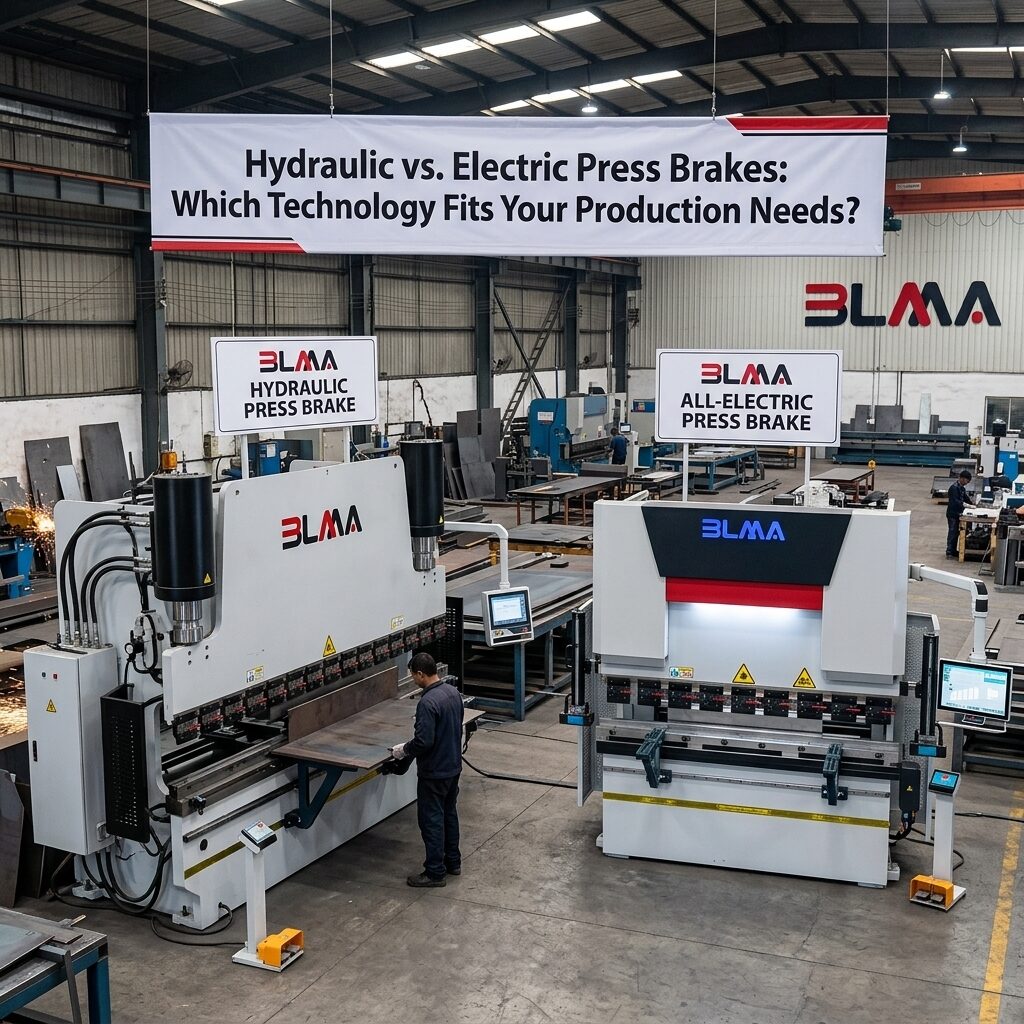
Choosing the right press brake is an important investment decision for any sheet metal fabrication business. The machine you select affects bending accuracy, production speed, energy consumption, maintenance requirements, and the overall cost of manufacturing each part.
Two technologies dominate the market: hydraulic press brakes and electric press brakes. Both can deliver precise, repeatable bending results, but they use different drive systems and offer different advantages depending on the application.
So, which is better: a hydraulic or electric press brake?
The answer depends on your production requirements. Hydraulic machines are often well suited to demanding applications that require substantial bending force and versatility. Electric press brakes can offer advantages in energy efficiency, responsiveness, and precision for suitable workloads.
In this guide, we compare hydraulic vs. electric press brakes, explain their key differences, and explore how to choose the right technology for your production needs.
1. How Do Hydraulic and Electric Press Brakes Work?
Before comparing performance, it is important to understand how each machine generates and controls bending force.
Hydraulic press brakes
Hydraulic press brakes use pressurized hydraulic fluid to drive cylinders that move the ram and bending tool. The machine's hydraulic system generates the force required to deform sheet metal against a die.
Modern CNC hydraulic press brakes combine hydraulic power with programmable controls, backgauges, and, depending on the model, systems for compensating for machine deflection and correcting bending angles.
Their main advantages include:
High bending force for demanding applications.
Flexibility across different materials and thicknesses, within the machine's rated capacity.
A broad range of machine sizes and configurations.
Suitability for both general fabrication and heavy-duty production.
Hydraulic systems require appropriate fluid maintenance, leak inspections, and attention to pumps, seals, valves, and other components. Their actual energy consumption depends on the hydraulic architecture, drive system, operating cycle, and workload.
Electric press brakes
Electric press brakes use electric servo motors and mechanical drive components to move the ram and generate the required bending force. Depending on the design, motion may be transmitted through ball screws, belt drives, or other mechanical systems.
Instead of relying on a conventional hydraulic circuit for the primary bending movement, the machine uses controlled electric motion.
Typical advantages include:
Responsive ram movement and precise positioning.
Potentially lower energy consumption during suitable production cycles.
No hydraulic oil circuit for the main bending drive.
Reduced noise from hydraulic pumps in many machine designs.
Good repeatability for precision sheet metal components.
However, electric machines are not automatically the best choice for every application. Their maximum bending force, working length, tooling compatibility, and ability to handle particular production demands must be evaluated against the actual specifications of the machine.
2. Hydraulic vs. Electric Press Brakes: Key Differences
The most useful comparison considers the entire production process rather than focusing on a single specification.
| Comparison factor | Hydraulic press brake | Electric press brake |
|---|---|---|
| Drive system | Pressurized hydraulic fluid and cylinders | Servo motors and mechanical drive components |
| Bending force | Available in a wide range of capacities, including heavy-duty configurations | Depends on machine design and rated capacity |
| Energy efficiency | Varies with hydraulic system design and operating cycle | Can be highly efficient in suitable workloads |
| Bending accuracy | High when properly configured, maintained, and programmed | High when properly configured, maintained, and programmed |
| Repeatability | Depends on controls, tooling, material consistency, and machine condition | Depends on controls, tooling, material consistency, and machine condition |
| Maintenance | Includes hydraulic fluid, filters, seals, and hydraulic components | Focuses on mechanical drives, servo systems, and electrical components |
| Noise | Hydraulic pumps can contribute to operating noise | Often quieter because there is no conventional hydraulic pump for the main drive |
| Best-fit applications | General fabrication, demanding bending, and high-force applications | Precision work, suitable repetitive production, and energy-conscious operations |
Important: These are general tendencies, not universal rules. A modern servo-hydraulic press brake may offer excellent energy efficiency and accuracy, while an electric machine may not be suitable for a particular job if its capacity or working dimensions are insufficient.
Energy consumption and efficiency
Energy consumption is often one of the first factors manufacturers consider when comparing press brake technologies.
In a conventional hydraulic system, the pump supplies hydraulic pressure to move the ram. Depending on the design, the pump may consume energy even when the machine is waiting between operations.
Electric press brakes can use energy more directly for commanded movements. Their consumption depends on the servo system, the force required, the movement profile, and the time spent in different operating states.
Nevertheless, comparing technologies based only on their drive systems can be misleading. Modern hydraulic machines may incorporate variable-speed pumps or other energy-saving features.
For a meaningful comparison, evaluate energy consumption under representative production conditions, including setup, idle time, bending cycles, and expected machine utilisation.
Accuracy and repeatability
Both technologies can deliver high-quality bending results.
The final accuracy depends on several factors:
Machine rigidity and mechanical condition.
CNC control capabilities.
Tooling quality and alignment.
Material thickness, hardness, and springback.
Backgauge positioning and part support.
Operator setup and process consistency.
Electric press brakes can provide precise control of ram movement and positioning. Hydraulic machines with advanced CNC controls and angle measurement systems can also achieve excellent results.
If your production involves tight tolerances, complex geometries, or demanding quality requirements, evaluate the complete machine configuration rather than assuming that one drive technology guarantees better accuracy.
Maintenance and operating costs
Hydraulic press brakes require regular attention to hydraulic fluid condition, filters, seals, connections, and other hydraulic components. Maintenance intervals depend on the manufacturer's instructions and actual operating conditions.
Electric press brakes avoid the hydraulic fluid and pump maintenance associated with a conventional hydraulic bending drive. However, they still require inspections of mechanical components, lubrication where specified, servo systems, electrical connections, and safety equipment.
The relevant question is not simply which machine requires less maintenance. It is which machine offers the most predictable maintenance costs, suitable service support, and acceptable downtime for your facility.
3. Which Press Brake Is Better for Your Production?
The best choice becomes clearer when you consider the parts you manufacture, the materials you process, and the way your production is organised.
Scenario 1: Heavy-duty bending and thick materials
If your business regularly bends thick steel plates, large structural components, or parts requiring substantial forming force, a hydraulic press brake may be the more practical choice.
Hydraulic machines are available in configurations designed for high tonnage and long working lengths. They can also accommodate demanding applications where substantial force must be maintained during the bending process.
However, machine selection must be based on more than material thickness alone. The required tonnage also depends on material strength, bend length, die opening, and the bending method.
Recommendation: Prioritise rated bending force, working length, tooling capacity, machine rigidity, and the manufacturer's application guidance. Do not select a machine based solely on its nominal tonnage.
Scenario 2: Precision components and repetitive bending
Manufacturers producing electrical enclosures, equipment housings, brackets, and other precision sheet metal components may benefit from an electric press brake.
Servo-driven systems can offer responsive movement and precise control, making them attractive for repeatable production processes where cycle consistency matters.
Nevertheless, material variation and springback can affect the final angle regardless of the drive technology. Tooling, CNC programming, and appropriate compensation remain essential.
Recommendation: Compare positioning performance, repeatability specifications, available angle measurement systems, and the time needed to achieve a stable production setup.
Scenario 3: High-mix, low-volume manufacturing
Job shops often manufacture many different parts in relatively small batches. Frequent changeovers, programming, and setup can account for a significant share of total production time.
In this environment, CNC functionality, programmable backgauges, quick-change tooling, and intuitive programming may have a greater impact on productivity than the drive system alone.
Both hydraulic and electric press brakes can be suitable for high-mix manufacturing.
Recommendation: Evaluate how quickly operators can switch between jobs, retrieve programs, configure tooling, and produce an acceptable first part. Choose the machine that best supports your actual product mix.
Scenario 4: Energy-conscious production
If your facility operates press brakes for extended periods, energy efficiency may be an important factor in controlling operating costs.
Electric press brakes can be attractive where their operating characteristics match the production cycle. Modern hydraulic machines with energy-efficient pump systems may also provide competitive performance.
To compare them fairly, request energy consumption data under comparable operating conditions and calculate the expected annual cost using your electricity tariff and planned utilisation.
Recommendation: Compare total energy use per representative production cycle or finished part, where reliable measurements are available, rather than relying on general claims about either technology.
4. Total Cost of Ownership: Look Beyond the Purchase Price
The initial purchase price is only one part of the financial decision.
A press brake is a long-term production asset, so the evaluation should include all major costs throughout its expected working life.
Energy costs
Estimate annual electricity consumption based on realistic production hours, machine utilisation, and the types of jobs you process.
If two machines have different purchase prices, their energy consumption may influence the long-term financial comparison. However, potential savings should be calculated using actual machine data rather than assumed percentages.
Maintenance and downtime
Consider routine servicing, spare parts, technical support, and the financial impact of unexpected stoppages.
A machine that is inexpensive to purchase may become costly if parts are difficult to obtain or downtime disrupts delivery schedules.
Productivity and labour
The number of parts produced per shift depends on the entire process, including loading, positioning, tool changes, programming, inspection, and unloading.
A faster ram movement does not necessarily translate into higher overall productivity if operators spend substantial time setting up jobs or handling parts.
Assess the complete production cycle, including the availability of automation and operator assistance where appropriate.
Tooling and future requirements
Tooling compatibility can affect both the initial investment and the flexibility of future production.
Check whether the machine supports your existing tools, the tooling systems you intend to purchase, and the types of bends required by your product range.
It is also worth considering whether your future workload may involve longer parts, more complex geometries, higher bending forces, or automated handling.
The goal is to minimise the total cost per acceptable finished part, not simply the purchase price of the machine.
5. A Practical Checklist for Choosing a Press Brake
Before requesting quotations, prepare a clear picture of your production requirements.
Use the following checklist to compare available machines.
Materials: Which grades of steel, stainless steel, aluminium, or other sheet materials do you process?
Thickness and bend length: What are your typical and maximum requirements?
Part geometry: Do you manufacture simple brackets, deep boxes, complex profiles, or large panels?
Production volume: Are your jobs primarily prototypes, small batches, or repetitive series?
Accuracy: What dimensional tolerances and bend-angle consistency do your customers require?
Changeovers: How often do you change tools, programs, or materials?
Automation: Would programmable backgauges, automatic angle measurement, or robotic handling improve your process?
Operating costs: What are your electricity prices, maintenance expectations, and downtime costs?
Service support: What technical assistance, training, and spare parts are available?
Future capacity: Will the machine support your planned production growth?
These questions help establish a technical specification before you compare individual models.
It is also useful to prepare several representative parts for evaluation. A demonstration using your actual material, tooling, and bending sequence can reveal practical differences that are difficult to identify from a catalogue.
6. Hydraulic or Electric Press Brake: The Final Decision
There is no single press brake technology that is best for every metalworking business.
Hydraulic press brakes remain a strong option for manufacturers that need versatile bending capabilities, substantial forming force, and configurations suited to demanding industrial applications.
Electric press brakes can be an excellent choice for operations that prioritise precise motion control, responsive operation, and energy efficiency under suitable production conditions.
For many manufacturers, the decisive factors are the required bending capacity, product mix, production volume, accuracy, operating costs, and available service support.
Before making a final decision, compare the specifications of individual machines, evaluate your most demanding parts, and calculate the expected total cost of ownership. This approach makes it easier to identify equipment that meets today's requirements without unnecessarily limiting future production.
Find the Right Press Brake for Your Production
At UDBU, selecting metalworking equipment should start with your manufacturing requirements, not just a machine specification or purchase price.
Whether you are expanding an existing fabrication workshop, upgrading your bending capabilities, or planning a new production line, evaluating the right press brake configuration can help you improve process consistency and make a more informed investment.
Explore the metalworking equipment solutions available through UDBU and contact our team to discuss your application. With a clear understanding of your materials, bending requirements, production volumes, and budget, you can identify a solution that fits your business today and supports its future development.