
Geometry Control of Parts After Heat Treatment: Modern Measurement Methods
Geometry Control of Parts After Heat Treatment: Modern Measurement Methods
Heat treatment of metals — such as hardening, tempering, normalizing, or carburizing — significantly increases the strength, wear resistance, and service life of parts. However, these processes often cause deformation, warping, and dimensional changes, which can lead to deviations from required tolerances.
Therefore, geometry control after heat treatment is an important stage in the metalworking production process. Modern measurement technologies allow manufacturers to detect deviations at an early stage and ensure consistent product quality.
Why Parts Deform After Heat Treatment
During heat treatment, metal undergoes significant temperature changes that create internal stresses. The main causes of geometry changes include:
uneven heating or cooling
changes in the metal structure
internal stresses in the material
complex part geometry
different wall thicknesses
Even small deviations can be critical for parts with high precision requirements, such as those used in mechanical engineering, aerospace manufacturing, or tooling production.
Key Parameters That Are Checked
After heat treatment, the following geometric characteristics are typically inspected:
linear dimensions
flatness and straightness
roundness and cylindricity
coaxiality of holes
parallelism and perpendicularity of surfaces
Both traditional and modern measurement methods are used to ensure accurate control.
Modern Methods for Measuring Part Geometry
Coordinate Measuring Machines (CMM)
Coordinate Measuring Machines are among the most precise tools for inspecting part geometry.
Their operating principle is based on measuring the coordinates of multiple points on the part’s surface using a contact probe or a laser sensor.
Advantages of this method include:
high measurement accuracy
ability to inspect complex geometries
automation of inspection processes
creation of a digital model of the part
CMM systems are widely used in serial production and high-precision manufacturing.
3D Scanning
Optical 3D scanners allow engineers to quickly create a digital model of a part and compare it with a CAD model.
Key advantages include:
high measurement speed
full surface analysis
detection of deformation and warping
clear visualization of deviations
This method is particularly useful for parts with complex shapes and large components.
Laser Measurement Systems
Laser systems are used for non-contact measurement of dimensions and geometry.
These systems allow manufacturers to:
perform measurements directly on the production line
monitor geometry in real time
measure hard-to-reach areas
Laser technologies are often used in automated production lines.
Optical Measurement Systems
Optical measurement systems use high-resolution cameras and specialized software to analyze the dimensions and geometry of parts.
Advantages include:
no physical contact with the part
high inspection speed
ability to measure very small elements
This method is particularly suitable for small and highly precise components.
Profilometers and Form Measuring Instruments
Profilometers are used to control surface quality and form accuracy.
They allow measurement of:
surface roughness
surface profile
micro-geometry
These measurements are especially important for parts where contact surfaces play a critical role.
Automation of Quality Control
Modern manufacturing companies increasingly implement automated quality control systems integrated directly into production lines.
Advantages of automation include:
reduced influence of human error
faster inspection of parts
automatic documentation of results
integration with production management systems
Such solutions help maintain stable product quality even in high-volume manufacturing.
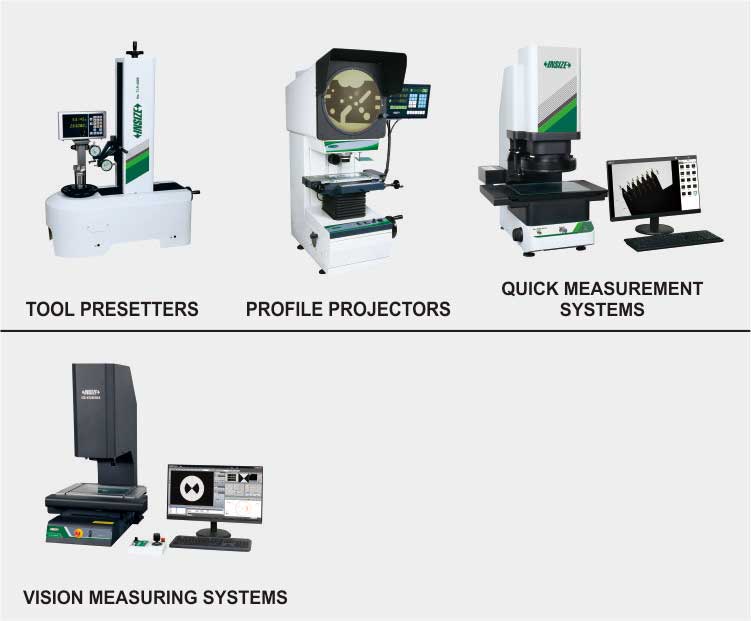 Equipment for Precision Measurement
To effectively control the geometry of parts after heat treatment, it is essential to use modern measuring equipment such as coordinate measuring machines, fast measurement systems, profilometers, laser micrometers, and other metrology tools.
The INSIZE catalog offers a wide range of instruments for controlling dimensions, shape, and surface quality — from manual measuring tools to high-precision automated inspection systems.
Need Measuring Instruments for Your Production?
UDBU organizes the supply of measuring equipment and instruments for metalworking companies.
We help you:
select measuring instruments suitable for your tasks
organize the supply of equipment from leading manufacturers
ensure optimal delivery times
Modern measurement systems help improve inspection accuracy, reduce scrap rates, and ensure consistent product quality.
Contact UDBU to find the right solution for geometry and quality control in your manufacturing process.