
Local vs. Centralized Oil Mist Filtration: Which System Is More Efficient?
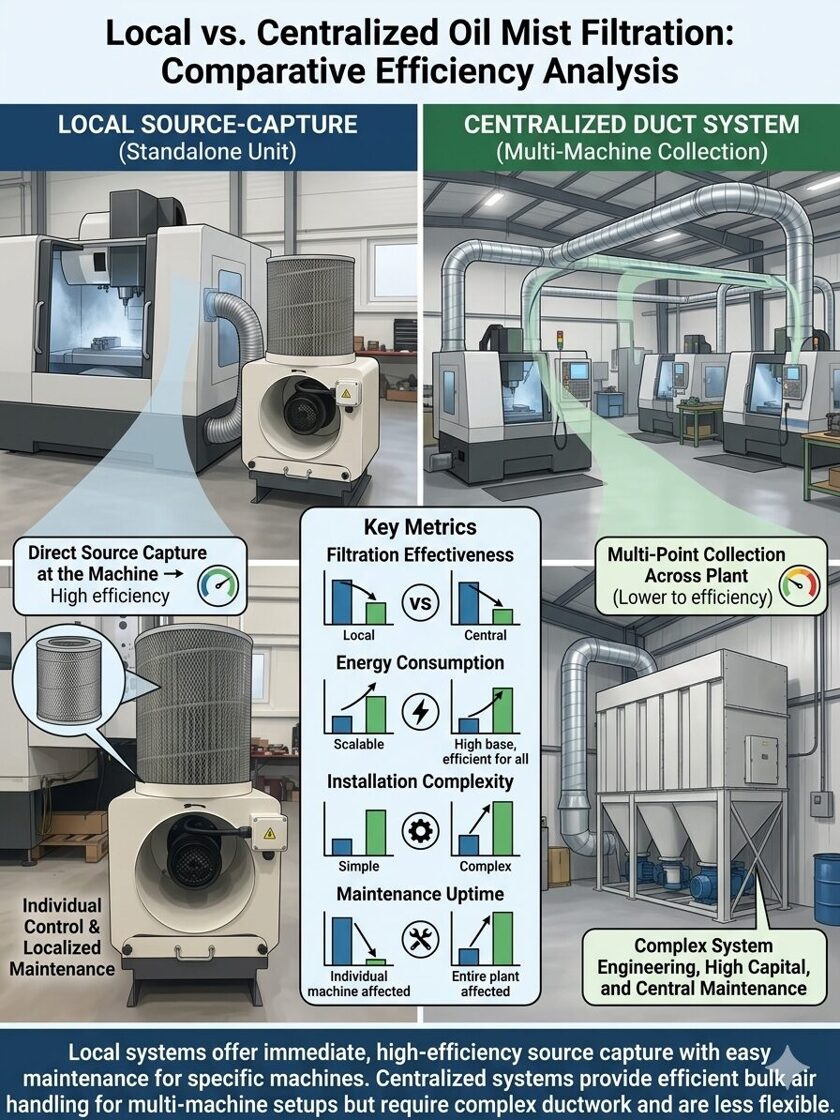 Local vs. Centralized Oil Mist Filtration: Which System Is More Efficient?
In metalworking companies, especially when working with CNC machines, milling, or grinding, oil mist often enters the air. This mist consists of fine aerosol droplets formed from cooling and lubricating fluids. These aerosols can negatively affect employee health, equipment performance, and increase contamination in the workshop.
To maintain a clean working environment, oil mist collectors are used. However, companies often face the question: is it better to choose a local filtration system for each machine or a centralized system for the entire workshop?
Let’s look at the advantages and disadvantages of both solutions.
Local Oil Mist Filtration
A local filtration system means that each CNC machine or piece of equipment has its own oil mist collector installed directly on the machine or nearby.
Advantages
High efficiency at the source – the mist is captured exactly where it is generated.
Easy installation – often no complex ventilation system is required.
Modular approach – new filters can be added as production grows.
Smaller air ducts or no ductwork at all.
Disadvantages
A larger number of units that must be serviced and maintained.
Each filter requires its own electrical connection and maintenance.
With many machines, total costs can increase.
Centralized Oil Mist Filtration
A centralized system uses one or several large filtration units that collect oil mist from multiple metalworking machines through air ducts.
Advantages
A unified filtration system for the entire workshop.
Fewer filtration units to maintain.
Often lower operating costs in large manufacturing facilities.
Can be integrated into the overall industrial ventilation system.
Disadvantages
Higher initial investment for ductwork and system design.
More complex installation.
If the central system stops, it can affect the entire production line.
When to Choose a Local System?
Local oil mist collection is usually the best solution if:
The company has a small or medium number of CNC machines.
Machines are located in different rooms or workshop zones.
Fast and flexible installation is required.
Production may frequently change or expand.
When Is a Centralized System Better?
Centralized filtration is more often chosen when:
A large metalworking plant operates many machines.
Machines are located in one large workshop.
The company wants a unified ventilation and air purification system.
Long-term operational optimization is the priority.
Which Solution Is More Efficient?
There is no universal answer.
For small and medium workshops, local filtration is often more efficient because it is flexible and easier to install.
For large factories with dozens of machines, a centralized system is often more advantageous because it reduces overall maintenance costs.
The most effective solution usually comes from analyzing the specific production process, the number of machines, and the layout of the workshop.
Conclusion
Both local and centralized oil mist filtration systems can provide high air purification efficiency. The right choice depends on the size of the company, the number of CNC machines, the structure of the facility, and long-term production plans.